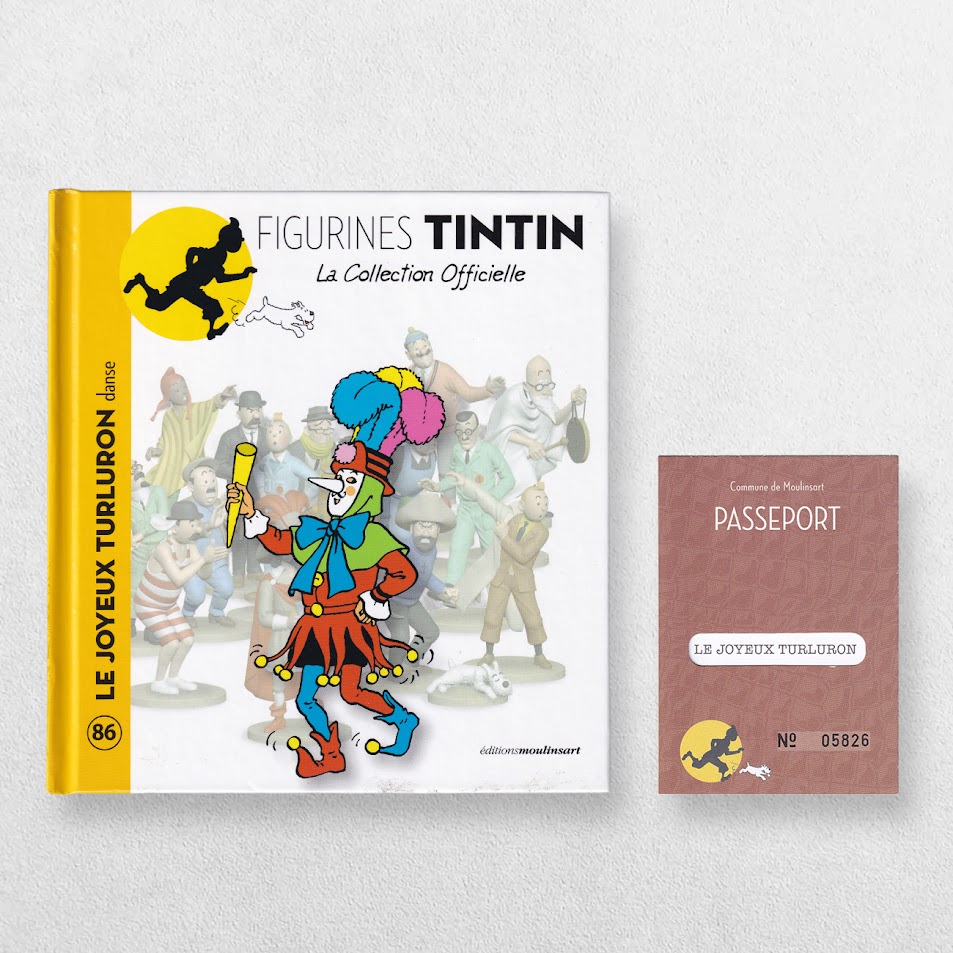
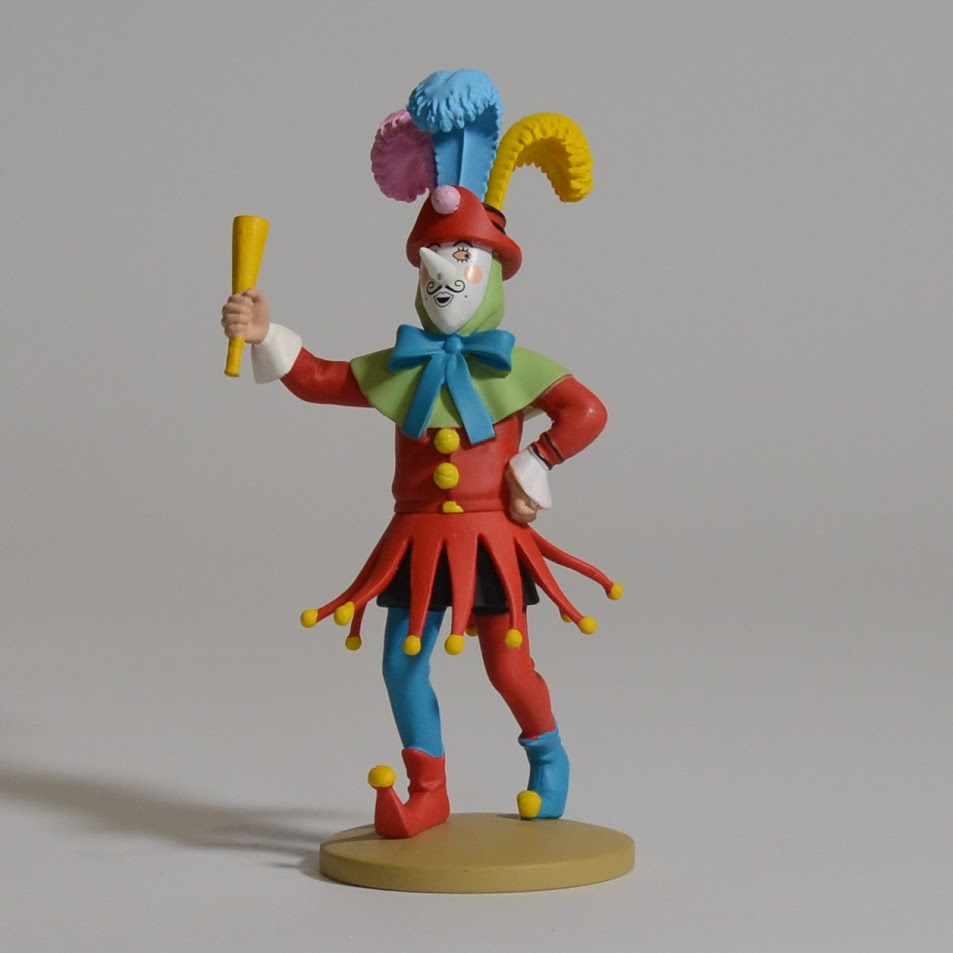
The Joyeux Turluron – Figurines Tintin La Collection Officielle – 86 – Le Joyeux Turluron Danse
Author: Hergé & Editions Moulinsart
Price: £125.00
Publisher: Editions Moulinsart
Publication date: 2015
Format: Original pictorial boards with passport and figurine
Condition: In near fine condition
Illustrations: Illustrated throughout
Description:
Original pictorial boards. Includes passport loosely inserted. Text in French. Includes the accompanying figurine. One from the collection of 111 books and figurines. Very slight wear. In very near fine, clean condition overall.
The Joyeux Turluron: A Short Biography
The Joyeux Turluron — literally “the merry reveller” or “the jolly rogue” — is a symbolic and atmospheric figure within the imaginative world of The Adventures of Tintin. While he does not appear as a named character in any single album, the phrase Le Joyeux Turluron encapsulates a distinct archetype that runs through Hergé’s universe: the carefree, comic, and cheerfully human presence that offsets the moral gravity of Tintin’s adventures.
The term, with its roots in old French idiom, suggests someone exuberant, irrepressible, and a little foolish — a person who lives for laughter and movement, even amid chaos. Whether read as metaphor, cultural motif, or embodiment of Hergé’s lightness of touch, The Joyeux Turluron stands for the laughter that redeems tension, the vitality that counters fear, and the optimism that balances intellect.
Origins and Etymology
The expression “turluron” derives from 18th- and 19th-century French colloquial speech. It referred to a merrymaker or buffoon, often a travelling entertainer, musician, or jester whose antics brought joy to everyday life. The addition of “joyeux” (meaning “happy” or “cheerful”) turns the phrase into a warm, affectionate description — less mocking than endearing.
In literary and visual culture, the Turluron evolved into a stock character: the good-hearted fool, untroubled by social ambition and unspoiled by cynicism. Hergé, a keen observer of human types, instinctively drew upon such archetypes to populate Tintin’s world.
Characterisation and Spirit
Though not a single person in Hergé’s canon, The Joyeux Turluron can be understood as a collective persona — a symbolic character embodied in various comic figures who bring humanity and humour to the stories.
Traits and Attributes
- Temperament: Cheerful, impulsive, and irrepressible
- Moral quality: Innocent rather than virtuous; foolish rather than wicked
- Speech and gesture: Animated, expressive, and spontaneous
- Social position: The everyman, often on the margins of seriousness
This archetype appears in multiple guises throughout The Adventures of Tintin: in Captain Haddock’s explosive humour, Bianca Castafiore’s melodramatic exuberance, or Séraphin Lampion’s bumbling optimism. Each represents a different facet of the Turluron — comedy as moral counterweight.
The Joyeux Turluron in Tintin’s World
- A Balancing Force
In Hergé’s narrative structure, Tintin himself is the axis of reason — moral, calm, and incorruptible. Around him, characters such as Haddock, Lampion, and even Snowy provide comic energy, warmth, and emotional contrast.
The Joyeux Turluron thus functions as a counterbalance: the laughter that prevents the stories from collapsing under their own seriousness. This balance is central to Hergé’s art, ensuring that moral integrity never shades into sanctimony.
- The Comic as the Human
For Hergé, humour was not an escape from truth but a means of expressing it. The Joyeux Turluron represents the resilient human spirit, the capacity to remain buoyant even amid danger.
In The Castafiore Emerald, for instance, the domestic absurdities at Marlinspike Hall — mistaken rumours, trivial scandals, and musical mishaps — are essentially the dance of the Turluron: comic life continuing in spite of fear and confusion.
- The Satirical Mirror
Hergé’s Turlurons also serve a satirical function. They expose vanity, pretence, and pomposity through laughter. Séraphin Lampion’s mindless cheerfulness and Professor Calculus’s oblivious eccentricity both parody human weakness — yet Hergé treats them with compassion rather than cruelty.
Moral and Symbolic Dimensions
- Joy as Resistance
The Joyeux Turluron embodies the idea that joy itself is a form of resistance — against cynicism, tyranny, and despair. In Hergé’s post-war Europe, this quality resonated deeply. The laughter of the Turluron is not trivial; it is defiant.
- Innocence and Folly
Where Tintin represents clear-sighted morality, the Turluron stands for the virtue of foolishness — the ability to err, blunder, and still remain kind. Through such characters, Hergé acknowledges that humanity’s value lies not in perfection, but in perseverance.
- The Eternal Comic Rhythm
The Turluron’s dance — implied by the phrase Le Joyeux Turluron danse — symbolises life’s cyclical comedy. Even after danger or disaster, movement continues. This lightness of being, so integral to Hergé’s art, connects the laughter of individuals to the enduring rhythm of human hope.
Cultural and Artistic Context
Hergé’s use of comic archetypes reflects his background in European visual satire and theatre. The Joyeux Turluron stands in the lineage of:
- The commedia dell’arte clown, who mocks authority through play.
- The 19th-century chanson performer, who laughs at his own misfortune.
- The Belgian caricature tradition, where humour softens critique.
In the context of The Adventures of Tintin, this tradition matures into a form of gentle moral comedy, where humour illuminates truth.
Visual and Tonal Resonance
Had Hergé illustrated a figure explicitly called The Joyeux Turluron, he would likely have drawn him:
- With open features and expressive eyes, suggesting innocence.
- Dressed colourfully, perhaps an entertainer or wanderer.
- Caught mid-movement — dancing, singing, or gesturing broadly — embodying vitality rather than intellect.
Even without this literal image, the spirit of the Turluron animates Hergé’s visual rhythm: bright, clear panels balanced by warmth and movement.
Philosophical Interpretation
At a deeper level, The Joyeux Turluron represents Hergé’s belief in the necessary coexistence of gravity and levity. Tintin’s world, for all its moral order, would be sterile without laughter; humour humanises justice.
This philosophy reflects Hergé’s own temperament — meticulous, introspective, yet deeply amused by the absurdity of life. The Turluron, in this sense, is Hergé’s alter ego: the part of him that delights in the comedy of the everyday, even while searching for meaning.
Legacy and Interpretation
The Joyeux Turluron lives on in the affectionate, often overlooked characters of Tintin’s universe — the talkative innkeeper, the bumbling inspector, the indignant shopkeeper. Together they form the chorus of laughter that gives the series its warmth and humanity.
Critics and Tintinologists regard this tone of comic compassion as one of Hergé’s hallmarks. Through the Turluron spirit, he transcended the adventure genre, turning it into a portrait of human resilience — absurd, fragile, but endlessly hopeful.
Summary
| Aspect | Description |
| Name | The Joyeux Turluron (The Jolly Reveller / The Merry Rogue) |
| Nature | Symbolic or archetypal figure within Hergé’s world |
| Traits | Cheerful, spontaneous, light-hearted, comic yet human |
| Function | Embodies humour, resilience, and balance within moral storytelling |
| Themes | Joy as resistance, folly as virtue, laughter as truth |
| Spirit Embodied By | Haddock, Lampion, Castafiore, and other comic figures |
| Symbolism | The eternal dance of life, art, and optimism |
Conclusion
The Joyeux Turluron is not a single man but a spirit — the spirit of laughter that breathes life into Hergé’s meticulously drawn world.
He is the rogue who dances when reason stops, the clown who speaks truth through folly, and the reveller whose joy restores balance to Tintin’s universe of peril and precision.
In this way, The Joyeux Turluron becomes more than a name or a phrase: he is a timeless emblem of Hergé’s humanism — proof that even in the face of danger or doubt, the heart may still dance.
Why Buy from Us?
At Hornseys, we are committed to offering items that meet the highest standards of quality and authenticity. Our collection of objects and rare books are carefully curated to ensure each edition is a valuable piece of bibliographical history. Here’s what sets us apart:
- Authenticity and Provenance: Each item is meticulously researched and verified for authenticity and collation.
- Expert Curation: Our selection process focuses on significance, condition, and rarity, resulting in a collection that is both diverse and distinguished.
- Customer Satisfaction: We aim to provide an exceptional customer experience, from detailed descriptions to secure and prompt delivery of your purchase.
- Returns Policy: We offer an unconditional guarantee on every item. If you wish to return an item, it may be sent back to us within fourteen days of receipt. Please notify us in advance if you wish to do so. The item must be returned in the same condition as it was sent for a full refund.
Cataloguer: Daniel Hornsey
Daniel Hornsey has specialised in fine and rare books, ephemera, and collectors’ editions for over thirty years. As a long-standing member of the antiquarian book trade, he has advised private collectors, curated catalogues, and sourced works for leading dealers, libraries and institutions across the world.
Hornseys’ exhibit regularly at book and map fairs in London and throughout the UK and are members of the Provincial Booksellers Fairs Association, the PBFA.
His fascination with Hergé’s work — especially ‘The Adventures of Tintin’ — began in childhood. Daniel recalls reading Tintin in original European editions and quickly recognising that these were not merely children’s books, but finely illustrated narratives crafted with artistic depth and wit.
As noted by the Musée Hergé in Louvain-la-Neuve, Hergé’s ‘ligne claire’ style has influenced generations of European comic artists and his original drawings and paintings command very high prices with his painting of ‘The Blue Lotus’ jar fetching £2.8m at auction in 2021.
By presenting these works through Hornseys’, he hopes to contribute to the continued appreciation of one of the 20th century’s most influential illustrators, helping new generations discover the artistry and legacy of Hergé.