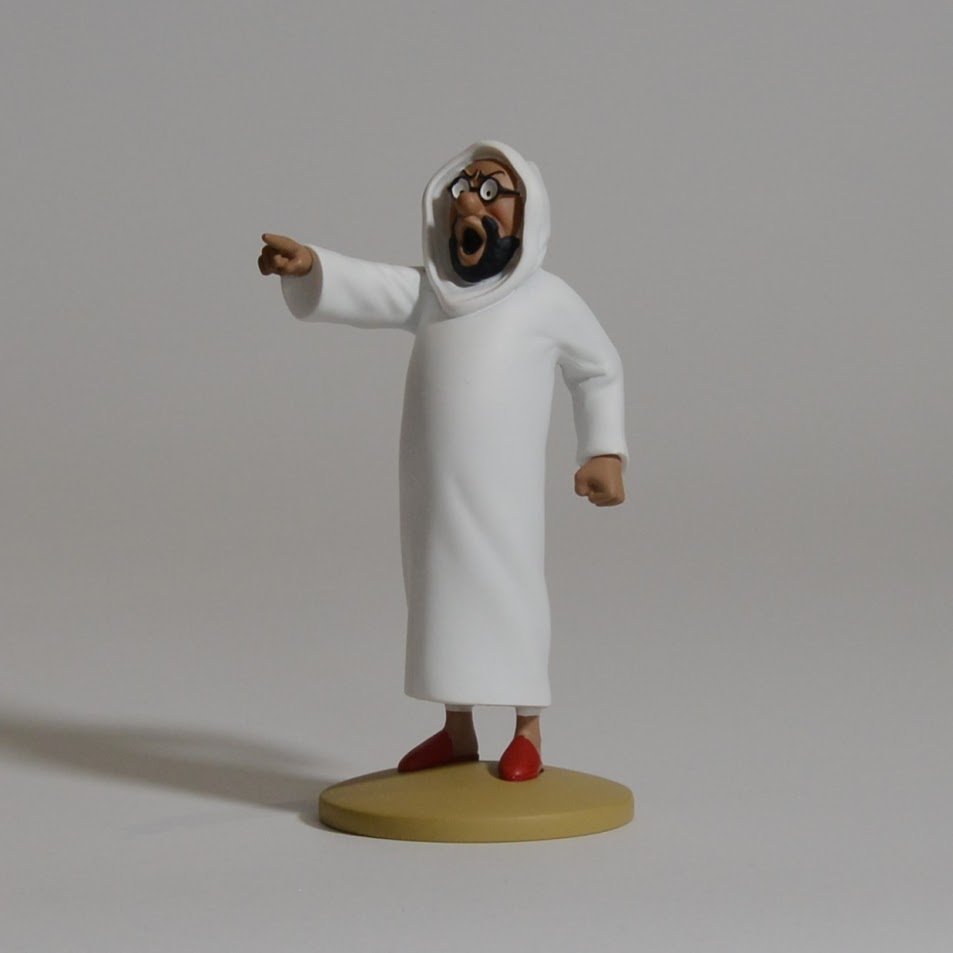
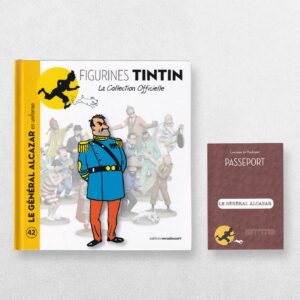
Omar Ben Salaad Merchant And Smuggler – Figurines Tintin La Collection Officielle – 89 – Omar Ben Salaad Négociant Et Trafiquant
Author: Hergé & Editions Moulinsart
Price: £95.00
Publisher: Editions Moulinsart
Publication date: 2015
Format: Original pictorial boards with passport and figurine
Condition: In near fine condition
Illustrations: Illustrated throughout
Description:
Original pictorial boards. Includes passport loosely inserted. Text in French. Includes the accompanying figurine. One from the collection of 111 books and figurines. Very slight wear. In very near fine, clean condition overall.
Omar Ben Salaad: A Short Biography
Omar Ben Salaad is a major antagonist in The Adventures of Tintin – The Crab with the Golden Claws (Le Crabe aux Pinces d’Or, first published 1941*). Introduced as a wealthy and respectable négociant (merchant) in the bustling North African port of Bagghar, he is later revealed to be the criminal mastermind behind a vast opium smuggling operation disguised through tinned crab exports.
With his dignified bearing, elegant dress, and air of refinement, Omar Ben Salaad represents one of Hergé’s most striking character studies in hypocrisy — a man whose outward civility conceals corruption and greed.
Character Overview
| Attribute | Description |
| Full Name | Omar Ben Salaad |
| Occupation | Merchant (cover); Smuggler and opium trafficker (true role) |
| First Appearance | The Crab with the Golden Claws (Le Crabe aux Pinces d’Or, 1941) |
| Nationality | North African (fictional city of Bagghar) |
| Affiliations | Leader of an international opium trafficking ring |
| Character Type | Villain; hypocrite; embodiment of dual morality |
| Notable Traits | Elegant, calculating, cultured yet ruthless |
Narrative Role in The Crab with the Golden Claws
- The Disguise of Respectability
Omar Ben Salaad is first introduced as a respected local businessman in Bagghar. His home is described as sumptuous — filled with fine furnishings, silks, and art — reflecting his apparent prosperity and social standing.
To the outside world, he is a cultured and honourable merchant. However, Tintin’s investigation into the mysterious crab tins soon uncovers his involvement in a major smuggling network operating across the Mediterranean.
- The Criminal Revelation
Tintin’s pursuit of the smuggling ring leads him to Salaad’s mansion, where the façade of respectability begins to crack. Through a combination of deductive reasoning and action, Tintin exposes him as the mastermind behind the opium traffic, a crime masked by legitimate trade in canned crab meat — the “golden claws” of the title referring to the distinctive crab tins used to conceal the drugs.
When confronted, Salaad’s urbane composure collapses into desperation. He attempts to flee but is ultimately captured, bringing his double life to an end.
Characterisation
- The Civilised Villain
Hergé portrays Omar Ben Salaad as the archetype of the civilised criminal — suave, intelligent, and socially integrated. Unlike the brutish Allan Thompson or the hapless dockworkers under his employ, Salaad wields power through money and manipulation, not violence.
His personality mirrors the polite façade of colonial commerce — the gentlemanly veneer concealing exploitation. In this way, he becomes not merely a smuggler but a symbol of moral duplicity within systems of trade and empire.
- Calm Authority
Throughout the story, Salaad maintains a calm, almost regal bearing. His dialogue is formal and measured, suggesting self-control and education. Yet this restraint only sharpens the shock of his eventual exposure: beneath the calm exterior lies ruthless ambition.
- Symbol of Duality
Hergé often used villains like Salaad to explore the conflict between surface order and hidden corruption. In this sense, Omar Ben Salaad’s elegant manners and criminal core echo the moral complexities of the modern world — where legality, wealth, and morality do not always align.
Themes and Symbolism
- Respectability and Corruption
Salaad’s role as both merchant and trafficker exemplifies Hergé’s recurring theme of hypocrisy among the powerful. He represents the idea that vice often hides behind respectability — a polished exterior masking greed and moral decay.
- East and West: Hergé’s Perspective
While Hergé’s early works sometimes reflected European stereotypes of “the exotic East,” Omar Ben Salaad’s portrayal is more nuanced than that of earlier villains. He is not a caricature of cruelty or primitiveness; rather, he is intelligent, cosmopolitan, and sophisticated — qualities that make his betrayal of morality even more chilling.
Through him, Hergé critiques not a culture, but corruption itself — the universal moral disease that transcends borders.
- The Mask and the Truth
Salaad’s double identity serves as a metaphor for deceit — a motif that recurs throughout The Crab with the Golden Claws. From the disguised opium tins to Salaad’s false merchant persona, the story is a study in appearance versus reality.
Tintin’s victory is therefore not merely physical but moral: he tears away the mask to expose the truth.
Artistic and Visual Depiction
In Hergé’s ligne claire style, Omar Ben Salaad is drawn with precision and elegance:
- Appearance: Dark complexion, neatly groomed beard, and refined features.
- Clothing: A luxurious robe or tailored suit, reflecting both wealth and vanity.
- Expression: Calm, calculating, and subtly sinister.
His composure visually contrasts with the more volatile Captain Haddock, who is introduced in the same story — a deliberate artistic choice highlighting the difference between raw humanity and moral concealment.
Moral and Psychological Interpretation
- The Corruption of Wealth
Salaad’s wealth, derived from crime, becomes a moral burden. His mansion — filled with opulence — symbolises both his success and his guilt. In this, Hergé foreshadows later villains like Rastapopoulos, who embody greed elevated to empire.
- Crime as Structure, Not Chaos
Unlike chaotic criminals, Omar Ben Salaad represents organised evil — the integration of crime into commerce. His operation mirrors a business enterprise, efficient and transnational. This makes him a chillingly modern villain, reflecting the real-world networks of smuggling and exploitation that Hergé, as a journalist, would have known about.
- The Fall of the Masked Man
Hergé frames Salaad’s downfall as a moral inevitability. His capture restores balance to a world momentarily disordered by deceit. Yet, true to the author’s humanism, the scene is not vindictive: justice is restored through truth, not revenge.
Cultural and Historical Context
When The Crab with the Golden Claws first appeared in 1941, the world was engulfed in war, and colonial systems were at their height. Hergé’s setting — a North African trading port — reflects contemporary fascination with exotic locales, but the story’s moral structure transcends time and geography.
Omar Ben Salaad’s combination of commerce and crime mirrors real-world anxieties about corruption, black markets, and moral compromise under global trade — themes still resonant today.
Relationship to Tintin and Haddock
Tintin
Omar Ben Salaad serves as Tintin’s intellectual adversary — cunning rather than violent, polished rather than impulsive. Tintin’s victory comes through observation and reasoning, a triumph of moral clarity over deceit.
Captain Haddock
In contrast, Salaad’s control and composure stand opposite Haddock’s humanity and chaos. The contrast between the merchant’s cold civility and the Captain’s explosive warmth defines the human spectrum that The Crab with the Golden Claws introduces and which underpins all later Tintin stories.
Summary
| Aspect | Description |
| Name | Omar Ben Salaad |
| Role | Merchant and opium smuggler |
| First Appearance | The Crab with the Golden Claws (1941) |
| Nationality | North African (fictional city of Bagghar) |
| Occupation | Businessman (cover); international drug trafficker (reality) |
| Traits | Polished, intelligent, deceitful, ruthless |
| Themes | Hypocrisy, moral corruption, appearance vs reality |
| Symbolism | The respectable façade masking evil |
| Fate | Exposed and arrested by Tintin, his operation dismantled |
Conclusion
Omar Ben Salaad stands as one of Hergé’s most effective portraits of corruption concealed beneath respectability. Unlike the bombastic villains of earlier adventures, he is quiet, cultured, and persuasive — a symbol of the modern, bureaucratic face of evil.
Through him, Hergé explores enduring moral questions: how power corrupts, how truth unmasks deceit, and how civilisation itself can become a disguise for exploitation.
When his mask is finally removed by Tintin, the revelation feels not merely like the capture of a criminal but the restoration of moral order — a moment of clarity in a world clouded by illusion.
Why Buy from Us?
At Hornseys, we are committed to offering items that meet the highest standards of quality and authenticity. Our collection of objects and rare books are carefully curated to ensure each edition is a valuable piece of bibliographical history. Here’s what sets us apart:
- Authenticity and Provenance: Each item is meticulously researched and verified for authenticity and collation.
- Expert Curation: Our selection process focuses on significance, condition, and rarity, resulting in a collection that is both diverse and distinguished.
- Customer Satisfaction: We aim to provide an exceptional customer experience, from detailed descriptions to secure and prompt delivery of your purchase.
- Returns Policy: We offer an unconditional guarantee on every item. If you wish to return an item, it may be sent back to us within fourteen days of receipt. Please notify us in advance if you wish to do so. The item must be returned in the same condition as it was sent for a full refund.
Cataloguer: Daniel Hornsey
Daniel Hornsey has specialised in fine and rare books, ephemera, and collectors’ editions for over thirty years. As a long-standing member of the antiquarian book trade, he has advised private collectors, curated catalogues, and sourced works for leading dealers, libraries and institutions across the world.
Hornseys’ exhibit regularly at book and map fairs in London and throughout the UK and are members of the Provincial Booksellers Fairs Association, the PBFA.
His fascination with Hergé’s work — especially ‘The Adventures of Tintin’ — began in childhood. Daniel recalls reading Tintin in original European editions and quickly recognising that these were not merely children’s books, but finely illustrated narratives crafted with artistic depth and wit.
As noted by the Musée Hergé in Louvain-la-Neuve, Hergé’s ‘ligne claire’ style has influenced generations of European comic artists and his original drawings and paintings command very high prices with his painting of ‘The Blue Lotus’ jar fetching £2.8m at auction in 2021.
By presenting these works through Hornseys’, he hopes to contribute to the continued appreciation of one of the 20th century’s most influential illustrators, helping new generations discover the artistry and legacy of Hergé.