Sebastian Münster – Cosmographia – Greece, Constantinople, Ottoman Sultans and Egypt – Nine Original Illustrated Leaves – Basel, 1588
Description
An unusually substantial and visually rich group of nine original double-sided leaves from Sebastian Münster’s celebrated Cosmographia, taken from the expanded late-sixteenth-century German edition published at Basel in 1588. The leaves vary slightly in size but measure approximately 33.2 x 21.8 cm, and together comprise eighteen printed pages dealing principally with Greece, Constantinople and the Ottoman Empire, before moving into Egypt.
This is a particularly appealing selection from Münster because the leaves contain not merely dense geographical text but an exceptional concentration of woodcut maps, city views, historical scenes, portraits of Ottoman rulers and other ethnographic and historical illustrations.
Münster’s Cosmographia was first published at Basel in 1544 and became one of the most successful geographical books of Renaissance Europe. It attempted nothing less than a description of the known world, combining geography, history, topography, ethnography, religion, natural history, political history and accounts of customs and peoples. The work was repeatedly enlarged after Münster’s death in 1552, ultimately appearing in numerous German and translated editions until 1628. Chetham’s Library describes it as a bestseller which gave readers information not only about geography but also towns, rulers, customs, occupations, flora, fauna, wonders and the peoples of the world.
The present leaves belong to the mature, greatly expanded form of the work represented by the 1588 German edition. A surviving facsimile description of that edition records more than 900 woodcuts, including approximately 247 city views and 40 maps, illustrating the extraordinary pictorial programme that by this date had accumulated around Münster’s original text.
Greece – “Griechenland nach seinen Landschaften und Eigenschafften”
One of the strongest leaves carries the heading:
“Griechenland nach seinen Landtschafften und eigenschafften”
and contains a substantial woodcut map of Greece and the Aegean region.
The map extends across the Greek mainland and surrounding islands, incorporating Macedonia, Thessaly, Epirus, the Morea or Peloponnese, Crete and neighbouring regions. Among the places and geographical names visible are Macedonia, Thessalia, Epirus, Morea, Constantinople and numerous Aegean islands.
This precise map and heading are independently recorded in the market as a woodcut from the 1588 edition of Münster’s Cosmographia, with an example measuring approximately 16 x 13 cm within the sheet.
The map is followed by Münster’s German description of Greece, its geography, inhabitants and historical associations.
Transylvania and the Ottoman Frontier
The reverse begins with material headed “Von dem Siebenbürgen”, concerning Transylvania, before introducing further material on the political and military geography of south-eastern Europe.
This part of Münster’s Cosmographia is particularly revealing of late-sixteenth-century European perceptions of the frontier between Christian Europe and the expanding Ottoman world. The fourth book of later editions covered Denmark, Scandinavia, Hungary, Poland, Lithuania, Russia, Wallachia, Bosnia, Bulgaria, Serbia, Greece and Turkey, placing the present group firmly within one of the work’s most politically charged geographical sequences.
Constantinople
Several pages are devoted directly to Constantinople, its rulers and its conquest.
One leaf carries the heading:
“Wie Constantinopel gewonnen ist von den Franckosen und Venedigern”
and includes a small but detailed woodcut showing the city and harbour during military activity.
Another page deals with:
“Wie Constantinopel vom Türcken gewonnen ist”
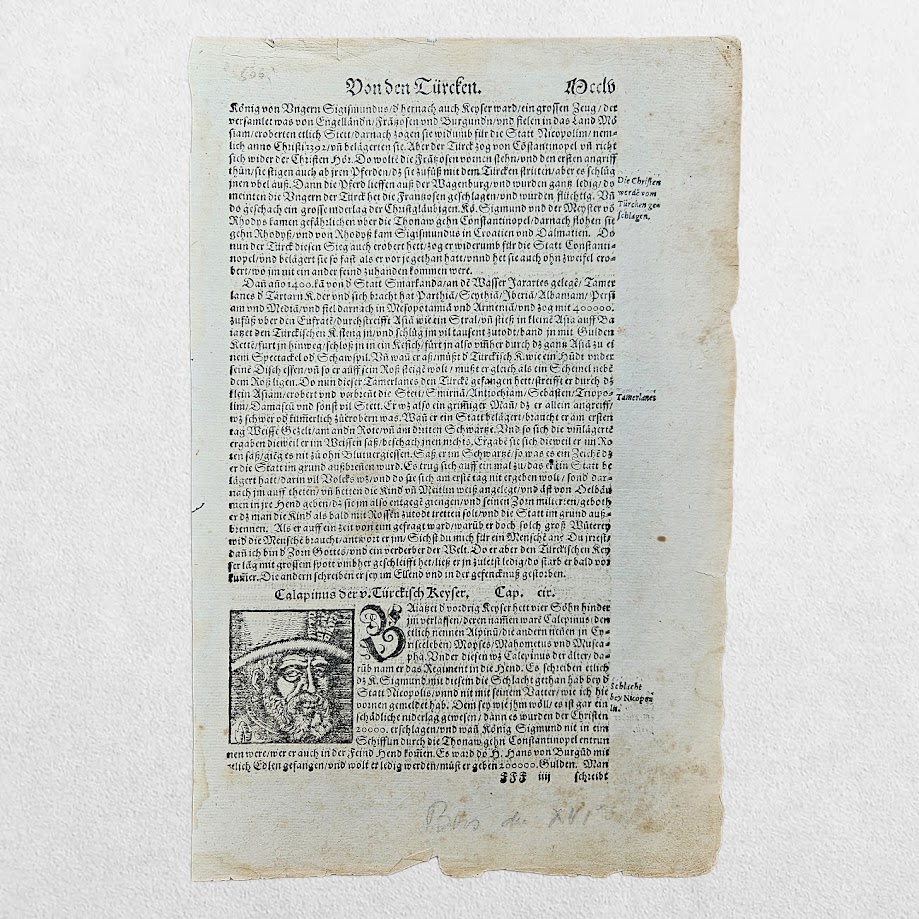
and incorporates a woodcut portrait of an Ottoman ruler.
A further large historical woodcut depicts an armed assault upon a fortified city, illustrating the turbulent military history through which Münster and his continuators explained the transformation of Constantinople from Byzantine capital to centre of the Ottoman Empire.
These scenes are not intended as eyewitness reportage in the modern sense. They belong to Münster’s encyclopaedic historical method, in which geography was inseparable from dynastic history, warfare, religion and the stories through which European readers understood distant places.
Athens
One of the leaves includes the chapter:
“Athen. Cap.”
followed by material on the ancient city and a portrait woodcut associated with Solon.
This reflects another characteristic of Münster’s work: modern geography is continually intertwined with classical history. Greece is presented simultaneously as a contemporary Ottoman-controlled territory and as the landscape of the ancient Greek world.
Ottoman Sultans
The Ottoman material is especially extensive and visually compelling.
Individual sections include portraits and biographies of successive rulers, amongst them:
Othomannus / Osman, founder of the Ottoman dynasty;
Orchanes / Orhan;
Amurates / Murad;
Baiaseth / Bayezid;
Solymanus / Süleyman;
and other Ottoman rulers.
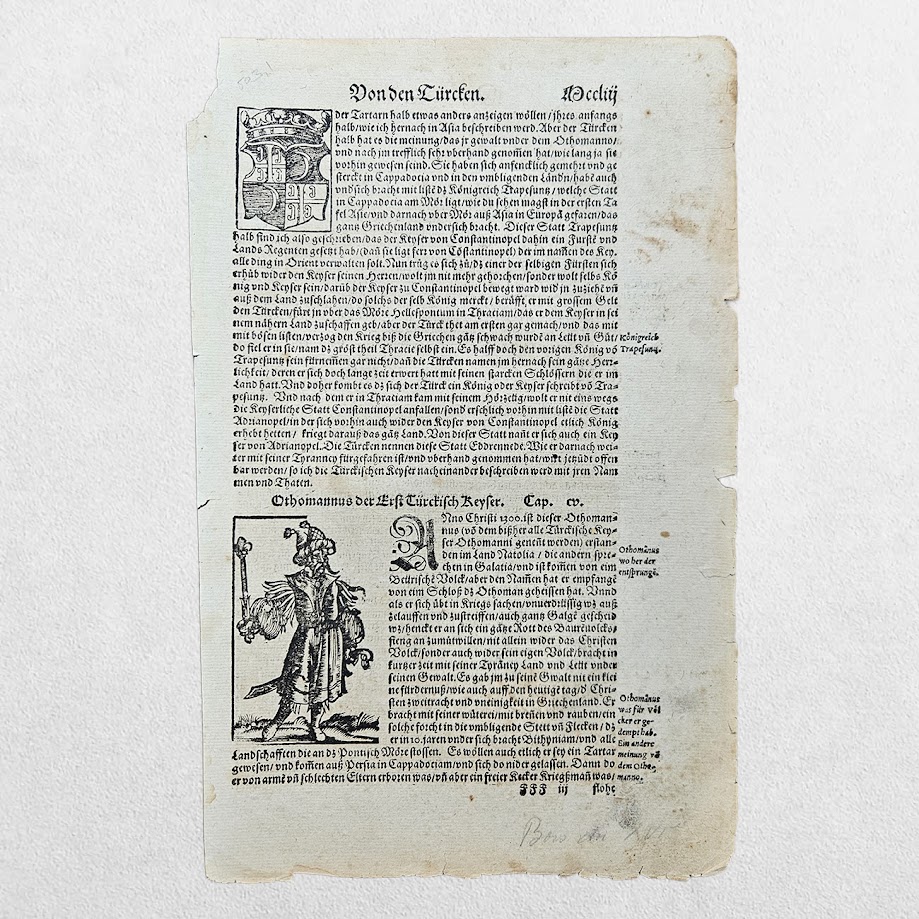
Several are represented by substantial profile or half-length woodcut portraits, frequently wearing distinctive turbans or Ottoman costume.
The pages include a succession of headings such as:
“Othomannus der Erst Türckisch Keyser”
and subsequent chapters describing rulers, military campaigns, conquests, dynastic succession and expansion into Byzantine and European territories.
The sequence is especially interesting as documentary evidence for the European visual construction of the Ottoman ruler during the sixteenth century. These are not objective portraits in the modern sense but Renaissance European representations, participating in a broad visual tradition through which western readers imagined Ottoman power.
The text itself continued to be expanded after Münster’s death as the Ottoman political situation changed. Material mentioning events well into the later sixteenth century demonstrates that these leaves belong to one of the expanded editions rather than Münster’s earliest lifetime printings.
The Turks and Ottoman Empire
Several leaves carry the running heading:
“Von den Türcken”
and discuss Ottoman origins, expansion, government, military activity and rulers.
The treatment combines genuine historical information with the assumptions, religious prejudices and polemical language characteristic of Christian European writing about the Ottoman Empire during a period of sustained political and military confrontation.
This context is important when interpreting the leaves today. Their significance is not that every statement is reliable, but that they provide direct primary-source evidence for how late-sixteenth-century European readers encountered and conceptualised the Ottoman world.
Persia
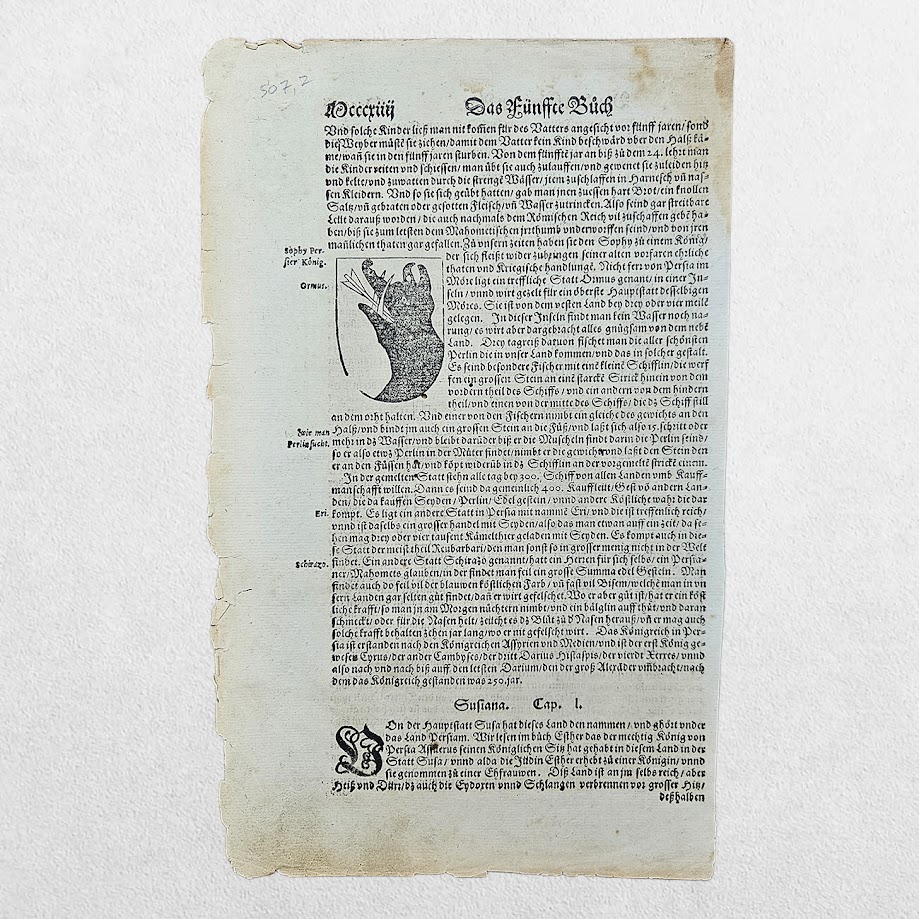
One leaf moves from Ottoman material into Persia, incorporating the striking woodcut device of an arm or hand and beginning a section dealing with the Persian kingdom.
The geographical progression illustrates the encyclopaedic organisation of the Cosmographia, moving eastward from Europe through the Ottoman territories towards Persia and the broader Asian world.
Egypt
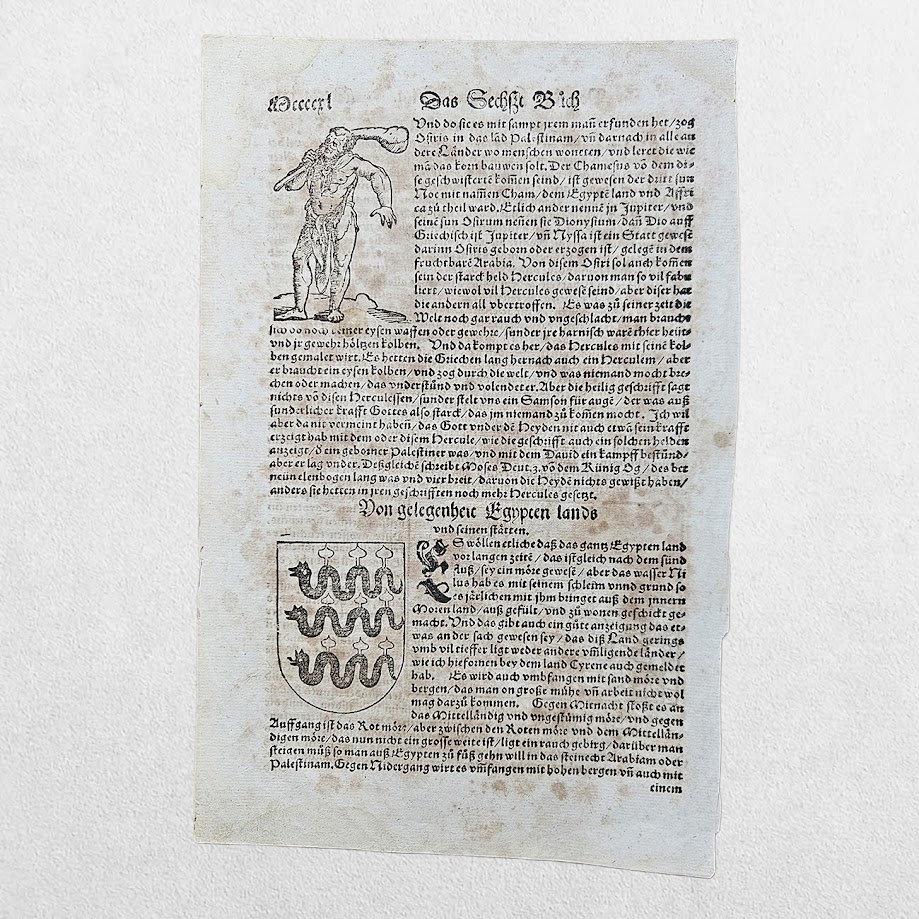
The final illustrated leaves move into Book Six and the section:
“Egypten land.”
One page contains a substantial woodcut landscape showing a wheeled cart or agricultural conveyance, figures and vegetation, accompanying Münster’s discussion of the fertility and natural character of Egypt.
The reverse continues with another striking figure and a heraldic or emblematic woodcut composed of serpentine forms while discussing the kingdom, customs and natural characteristics of Egypt.
The presence of Greece, the Ottoman world and Egypt within this single group gives the leaves considerably greater thematic coherence than an arbitrary collection of detached Cosmographia pages.
Sebastian Münster
Sebastian Münster (1488–1552) was a German Hebraist, theologian, cartographer and cosmographer whose Cosmographia became one of the defining geographical publications of Renaissance Europe.
First published in German in 1544, it was the earliest major German-language description of the world and subsequently appeared in numerous editions and translations. It combined contemporary geographical knowledge with historical texts, classical authorities, travellers’ accounts and an enormous programme of maps and woodcut illustrations.
The popularity of the work was extraordinary. Its later editions continued to incorporate newly available information and illustrations long after Münster’s death. The German edition remained in print until 1628.
The 1588 Edition
The 1588 Basel edition represents one of the heavily illustrated mature versions of the Cosmographia. A modern facsimile description based upon the Bayerische Staatsbibliothek copy records more than 900 woodcuts, including hundreds of town views and dozens of maps.
The identification of the present group with this edition is particularly supported by the Greece map headed “Griechenlandt nach seinen Landtschafften und eigenschafften”, for which another original example is specifically recorded as coming from Münster’s 1588 Cosmographia.
Condition
Good overall condition for nine original leaves more than four centuries old, with variations between individual sheets.
There is general age-toning, scattered spotting and staining, occasional foxing, light surface marking and varying degrees of marginal browning.
A number of leaves show:
- irregular or worn edges;
- small marginal losses;
- short tears and old folds;
- occasional minor worming or small holes;
- some corner creasing;
- historical pencil inscriptions and annotations;
- occasional areas of old strengthening or handling wear.
Several leaves have manuscript pencil identifications such as “Türkei”, “Ungarn” or similar later collector’s notes.
Despite these faults, the overwhelming majority of the printed areas remain complete, dark and clearly legible, while the principal woodcuts — including the Greece map, Constantinople scenes, Ottoman portraits, city views and Egyptian subjects — remain strong and attractive.
The set has not been artificially cleaned or restored to remove the evidence of its long history.
Please examine all photographs carefully as they form an integral part of the condition description.
Author: Sebastian Münster (1488–1552)
Work: Cosmographia
Edition: German edition, Basel, 1588
Place: Basel
Date: 1588
Number of Leaves: Nine original double-sided leaves
Number of Printed Pages: Eighteen
Size: Various, approximately 33.2 x 21.8 cm
Language: German.
Printing: Letterpress in German black letter with numerous original woodcut illustrations.
Principal Subjects
Greece; map of Greece and the Aegean; Transylvania; Constantinople; Ottoman Empire; Ottoman sultans; Athens; Solon; Persia; Egypt; Renaissance geography; ethnography and history.
Illustrations
Includes:
- woodcut map of Greece and the Aegean;
- view / siege scene of Constantinople;
- Ottoman ruler portraits;
- Ottoman costume and historical figures;
- military scenes;
- classical portraits;
- Persian imagery;
- Egyptian landscape and ethnographic woodcuts;
- numerous decorative historiated initials.
Authentication and Research
These leaves have been handled, inspected and catalogued in-house at our Ripon gallery.
Their identification has been established from the printed running headings, chapter titles, geographical sequence, typography and distinctive woodcuts. The Greece map has been compared with an independently catalogued example specifically identified as originating from the 1588 German edition of Sebastian Münster’s Cosmographia.
The wider structure and subject sequence have been checked against institutional and scholarly descriptions of Münster’s Cosmographia and its later German editions.
Why buy from us?
At Hornseys, we are committed to offering items that meet the highest standards of quality and authenticity. Our book collection is meticulously curated to ensure that each edition is a valuable and authentic piece of bibliographical history. Here’s what sets us apart:
- Authenticity and Provenance: Every book is researched, collated, and verified for authenticity.
- Expert Curation: Each book is selected with a keen eye for significance, condition, and rarity, ensuring a collection that is both diverse and distinguished.
- Customer Satisfaction: We strive to provide an exceptional customer experience, from detailed descriptions and provenance to secure and prompt delivery of your purchase.
- Returns Policy: We offer an unconditional guarantee on every item. If you wish to make a return, books may be sent back to us within fourteen days of receipt for any reason. We request advance notification of returns, and books must be returned in the same condition as sent for a full refund.
Explore Our Collection:
Visit Hornseys to explore our fine collection of rare and signed books. Whether you are an avid collector or looking for a special gift, our selection offers something truly unique. Located in the picturesque Yorkshire Dales, our Ripon gallery has been a haven for book lovers, art enthusiasts, and collectors since 1976.














![HORTUS SANITATIS [ORTUS SANITATIS] - DE AVIBUS - HARPY, SWALLOW, GYRFALCON AND IBIS - ORIGINAL INCUNABLE WOODCUT LEAF - STRASBOURG, JOHANN PRÜSS - NOT AFTER 21 OCTOBER 1497](https://hornseys.com/wp-content/uploads/2026/08/003988_1-300x300.jpg)


