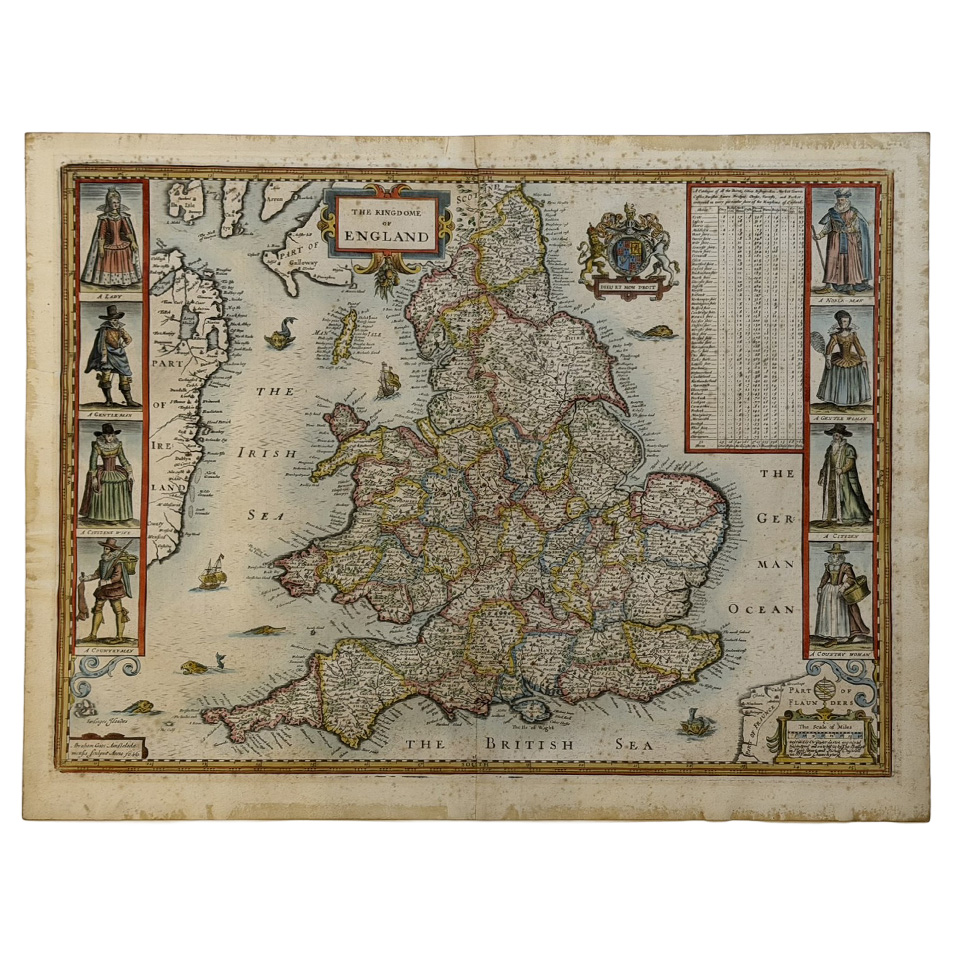
The Kingdome Of England – 1646
Author: Speed, John & Saxton, Christopher
Publisher: Thomas Bassett & Richard Chiswell
Price: £950 including postage in the UK
Publication Date: c.1646
Edition: First edition thus
Sheet Size: 55.8cm x 43.7cm
Condition: Very good
Condition:
Date: c.1646. Original copper-engraved map based on the work of Christopher Saxton. Early hand-colouring. English text verso. Includes decorative sea monsters in the Irish sea and German Ocean. Sheet size: 55.8cm x 43.7 margins. Short, repaired closed tear to the left hand margin. Map a little foxed and age-toned. Crease to upper margin. Remnants of tape verso. In very good, bright, condition overall. Scarce.
John Speed: A Short Biography
Overview
John Speed was one of the most influential figures in the development of English cartography and historical geography in the late sixteenth and early seventeenth centuries. Although not formally trained as a scholar in his youth, Speed combined practical craftsmanship, antiquarian learning, and royal patronage to produce works that shaped how England, Wales, Ireland, and Scotland were visualised and understood for generations. His atlases and historical writings stand at the intersection of Renaissance humanism, state formation, and the expanding print culture of early modern England.
- Early Life and Background
Origins and Family
John Speed was born in 1552 in Farndon, Cheshire, into a modest household. His father was a tailor, and Speed himself was apprenticed into the same trade. This background placed him firmly outside the traditional university-educated scholarly elite that dominated historical and geographical writing in Tudor England.
Despite these humble beginnings, Speed demonstrated early intellectual curiosity and aptitude, particularly in chronology, genealogy, and historical narrative. His later achievements are notable precisely because they emerged from a working artisan milieu rather than a clerical or academic one.
Apprenticeship and London Life
Speed moved to London as part of his trade training and joined the Merchant Taylors’ Company, one of the city’s most powerful livery companies. London exposed him to:
- The world of printing and publishing
- Antiquarian circles interested in Britain’s past
- Networks of patronage linking scholars, courtiers, and craftsmen
It was in London that Speed’s intellectual ambitions began to crystallise.
- Transition from Craftsman to Scholar
Intellectual Self-Education
Speed was largely self-taught. He educated himself through:
- Reading chronicles and classical histories
- Studying maps and manuscripts
- Engaging with other antiquaries
This autodidactic path shaped his approach: practical, synthetic, and oriented towards clarity rather than abstract theory.
Patronage and Support
A decisive turning point came when Speed attracted the attention of Sir Fulke Greville, a prominent courtier and intellectual. Greville provided Speed with:
- Financial assistance
- Social legitimacy within learned circles
- The freedom to pursue scholarly work full-time
Without this patronage, Speed’s major publications would almost certainly not have been possible.
- Speed the Antiquary and Historian
Historical Interests
Before becoming famous as a mapmaker, Speed established himself as a historian and antiquary. His historical work was characterised by:
- A strong interest in English national history
- Emphasis on monarchy, succession, and continuity
- Integration of biblical, classical, and medieval sources
Speed believed that geography and history were inseparable: understanding the land was essential to understanding the past.
The History of Great Britaine
Speed’s most ambitious historical work was The History of Great Britaine, published in the early seventeenth century. It offered:
- A continuous narrative from ancient Britain to Norman times
- Genealogies of kings and nobles
- A unifying vision of English and British history
While later historians would criticise aspects of his chronology and source criticism, the work was widely read and respected in its own time.
- Cartographic Achievement: The Theatre of the Empire of Great Britaine
Conception and Scope
Speed’s greatest and most enduring achievement was The Theatre of the Empire of Great Britaine, published in 1611–12. This was the first atlas to map:
- All the counties of England and Wales systematically
- With accompanying town plans, coats of arms, and historical text
The atlas was both a geographical survey and a political statement, presenting Britain as a coherent, ordered realm.
Relationship to Earlier Cartographers
Speed built directly upon the earlier work of Christopher Saxton, whose county surveys formed the cartographic foundation of the atlas. Speed’s originality lay in:
- Refining and standardising county maps
- Adding decorative and symbolic elements
- Integrating maps with historical commentary
He did not claim novelty where none existed; rather, he synthesised and elevated existing material into a comprehensive national vision.
Design and Iconography
Speed’s maps are distinctive for their rich visual content:
- Heraldry of counties and prominent families
- Insets of principal towns
- Allegorical figures and royal imagery
These features served not merely decorative purposes but reinforced ideas of hierarchy, loyalty, and national identity.
- Speed and the Politics of Union
Britain as a Concept
Speed worked during the reign of James VI and I, a period marked by attempts to promote the idea of a united Britain. His cartographic and historical work reflected this political climate:
- The term “Great Britaine” was used prominently
- Scotland and Ireland were increasingly framed as parts of a broader imperial structure
- England was presented as the administrative and cultural core
Although his work predated formal political union, it contributed to the imaginative geography that made union thinkable.
- Methods, Strengths, and Limitations
Strengths
- Exceptional synthesis of mapmaking and historical narrative
- Accessibility to a broad readership
- Clear visual language that shaped popular understanding
Limitations
- Reliance on inherited sources without rigorous source criticism
- Occasional chronological inaccuracies
- A strongly monarchical and providential interpretation of history
These limitations reflect the norms of early modern scholarship rather than personal failing.
- Later Life and Death
Speed continued to revise and expand his works throughout his later years. He remained respected among antiquaries and printers, though he never achieved great wealth.
He died in 1629 and was buried in London, leaving behind a legacy that outlived him by centuries. His works continued to be reprinted and adapted well into the later seventeenth century.
- Reputation and Legacy
Contemporary Reputation
In his lifetime, Speed was regarded as:
- A serious historian
- A reliable compiler of geographical knowledge
- A figure who brought learning to a wider public
Long-Term Influence
John Speed’s influence endures because:
- His maps shaped how England and Wales were imagined spatially
- His atlases became standard reference works
- He helped establish cartography as a tool of national self-understanding
Although modern historians approach his work critically, Speed remains a foundational figure in the history of British cartography and antiquarianism.
Concluding Assessment
John Speed was not a revolutionary theorist but a master synthesiser. Emerging from a craft background, he harnessed the tools of print, patronage, and Renaissance learning to produce works that defined early modern Britain’s sense of itself. His achievement lay in making history visible on the map, and the map intelligible through history—an intellectual legacy that continues to inform how Britain’s past is visualised and understood.
Why buy from us?
At Hornseys, we are committed to offering items that meet the highest standards of quality and authenticity. Our collection is meticulously curated to ensure that each item is a valuable and authentic piece of history. Here’s what sets us apart:
- Authenticity and Provenance: Every item is researched, collated, and verified for authenticity.
- Expert Curation: Each item is selected with a keen eye for significance, condition, and rarity, ensuring a collection that is both diverse and distinguished.
- Customer Satisfaction: We strive to provide an exceptional customer experience, from detailed descriptions and provenance to secure and prompt delivery of your purchase.
- Returns Policy: We offer an unconditional guarantee on every item. If you wish to make a return, items may be sent back to us within fourteen days of receipt for any reason. We request advance notification of returns, and items must be returned in the same condition as sent for a full refund.
Explore Our Collection:
Visit Hornseys to explore our fine collection of rare and signed books, maps, artwork and objects. Whether you are an avid collector or looking for a special gift, our selection offers something truly unique. Located in the picturesque Yorkshire Dales, our Ripon gallery has been a haven for book lovers, art enthusiasts, and collectors since 1976.
Thank you for looking.