Tintin 1/24 Model Car 29932 – La Voiture de la Castafiore – Le Sceptre d’Ottokar
Author: Hergé & Editions Moulinsart
Manufacturer: Editions Moulinsart / Tintinimaginatio
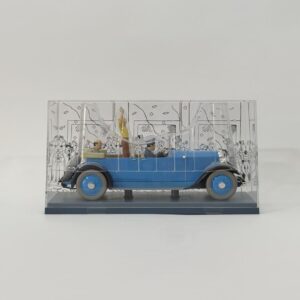
Format: 1/24 scale model car on display plinth with illustrated diorama and clear acetate case
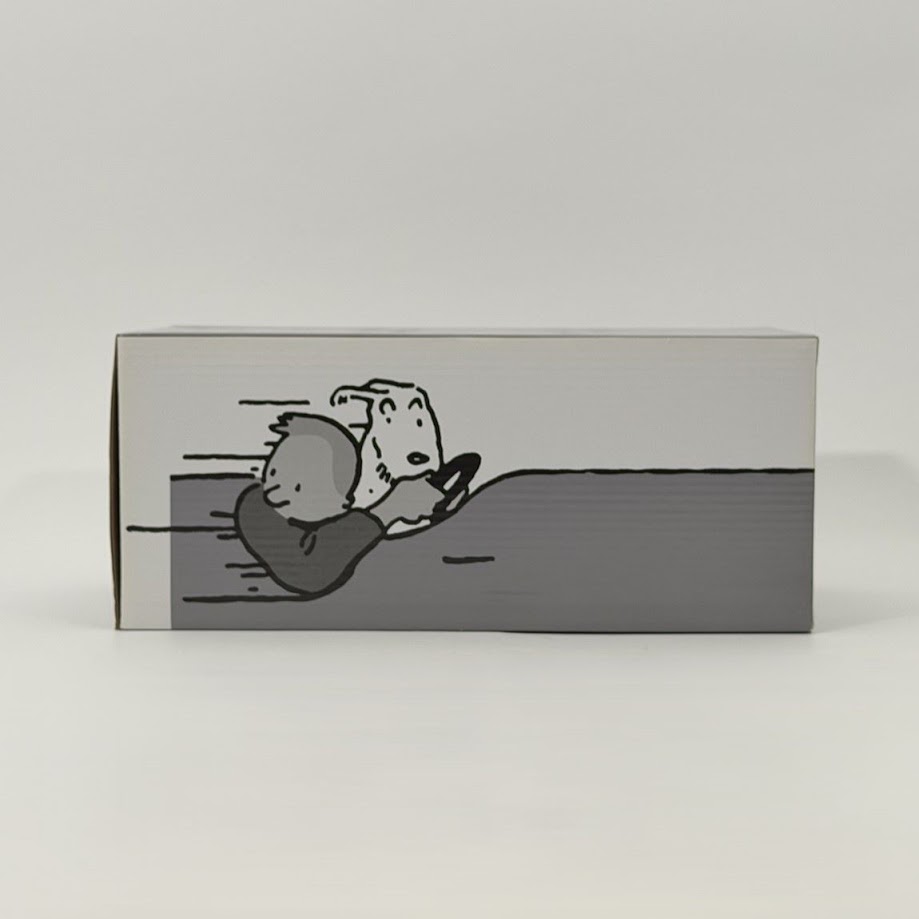
Condition: Fine. Ex-display model in fine condition. Complete with original grey and white outer box and explanatory booklet. The outer box has minor shelf-wear.
Description
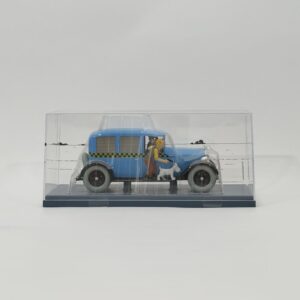
From the official Les Voitures de Tintin collection, this substantial 1/24 scale model of La Voiture de la Castafiore, reference 29932, recreates the elegant blue motor car associated with Bianca Castafiore in Hergé’s Le Sceptre d’Ottokar (King Ottokar’s Sceptre).
The model depicts the large blue saloon travelling through the mountainous Syldavian landscape, with its occupants visible through the windows. It is presented on its original display plinth beneath a clear acetate case, against a monochrome background taken from the visual world of the album.
Produced by Editions Moulinsart as number 32 in the 1/24 scale Tintin vehicle collection, the model is particularly attractive for its restrained blue bodywork, contrasting black wings, cream wheels and substantial inter-war saloon proportions. At this scale, details such as the bonnet vents, chrome-effect trim, door furniture, glazing and interior figures can be appreciated clearly.
The car appears in Le Sceptre d’Ottokar, the adventure in which Tintin travels to the fictional Balkan kingdom of Syldavia and becomes involved in a plot against King Muskar XII. Bianca Castafiore, the celebrated operatic soprano who would become one of the series’ best-known recurring characters, makes her first appearance in this album.
Her motor car forms part of that introduction. Castafiore is already presented with the mixture of grandeur, theatricality and good intentions that would define her later appearances, and the substantial chauffeur-driven-looking saloon is entirely appropriate to her larger-than-life personality.
This example has previously been displayed but remains in fine condition. It retains its original clear presentation case, grey and white outer cardboard box and explanatory booklet. The outer box has minor shelf-wear, consistent with storage and handling.
Reference: 29932
Scale: 1/24
Model: La Voiture de la Castafiore
Album: Le Sceptre d’Ottokar
Character association: Bianca Castafiore
Colour: Blue with black wings
Material: Resin, metal and plastic
Presentation: Display plinth with illustrated diorama and clear acetate case
Packaging: Original grey and white outer box, with minor shelf-wear
Documentation: Original explanatory booklet
Condition: Fine; ex-display
EAN: 2993200000001
La Voiture de la Castafiore: A Brief Account
This blue saloon is associated with the first appearance of Bianca Castafiore, one of the most memorable supporting characters in The Adventures of Tintin.
Castafiore is encountered during Tintin’s journey through Syldavia. Already a celebrated opera singer, she is presented with the imposing personality, theatrical manner and formidable singing voice that would become inseparable from the character.
Her arrival provides one of the characteristic tonal shifts in Le Sceptre d’Ottokar. Tintin is deeply involved in uncovering a political conspiracy, yet Hergé introduces an operatic celebrity whose presence temporarily transforms the atmosphere into comedy.
The car reinforces Castafiore’s status. It is a substantial, well-appointed saloon rather than an inexpensive everyday vehicle, visually establishing that its passenger is someone accustomed to travelling in comfort and being treated as a person of consequence.
Bianca Castafiore
Bianca Castafiore, known as the “Milanese Nightingale”, became one of Hergé’s most enduring recurring characters.
A celebrated soprano, she is most closely associated with her performance of the Jewel Song from Gounod’s Faust, a piece which Captain Haddock comes to dread after repeated encounters with her.
Although frequently used for comic effect, Castafiore is not simply a caricature. She is confident, generous, loyal and entirely unaffected by the anxiety she can cause those around her. Her personality is enormous, but so too is her affection for Tintin and his friends.
Her first appearance in King Ottokar’s Sceptre is therefore important within the history of the series. The character subsequently returns in several adventures and eventually becomes central to Les Bijoux de la Castafiore (The Castafiore Emerald).
Le Sceptre d’Ottokar: A Brief Account
Le Sceptre d’Ottokar is one of the key Tintin adventures of the late 1930s and introduces the fictional kingdom of Syldavia.
Tintin becomes involved after discovering suspicious circumstances surrounding Professor Alembick, a specialist in seals and heraldry who is travelling to Syldavia to study the royal archives.
The mystery develops into a conspiracy against King Muskar XII. The plotters intend to steal the Sceptre of Ottokar, a symbol of royal legitimacy whose absence during the annual ceremony of Saint Wladimir would force the King to abdicate.
Hergé created an unusually complete fictional country for the adventure, with its own monarchy, heraldry, national dress, language, history and political institutions.
Against this backdrop, the Castafiore episode provides a memorable moment of character comedy while also introducing a figure who would become increasingly important within the Tintin universe.
Syldavia and Hergé’s World-Building
Syldavia is one of Hergé’s most successful fictional settings.
Its architecture, landscape, costume and political traditions combine influences drawn from Central and South-Eastern Europe, while real contemporary automobiles and other technologies help make the invented country feel credible.
Vehicles therefore perform an important role in the album. They connect the imaginary kingdom with the recognisable modern world and help establish the social position of the characters who use them.
Castafiore’s blue saloon is an excellent example. The car is entirely plausible as period European transport, yet within the story it becomes part of the visual identity of an extravagant operatic celebrity.
Hergé and the Motor Car
Motor vehicles are a major component of Hergé’s visual storytelling.
A car can indicate wealth, profession, nationality or personality before a character speaks. Hergé increasingly exploited these possibilities as his draughtsmanship and research became more sophisticated.
The vehicle associated with Castafiore has the dignity expected of a large inter-war saloon. Its long bonnet, separate wings and generously proportioned cabin contrast strongly with smaller cars appearing elsewhere in the Tintin adventures.
The clear outlines and broad areas of colour also make the vehicle particularly well suited to Hergé’s developing ligne claire aesthetic.
The 1/24 Moulinsart Model
La Voiture de la Castafiore was issued as number 32 in the large-format Les Voitures de Tintin collection.
The 1/24 scale allows the car’s substantial proportions and passenger figures to be appreciated much more readily than in smaller Tintin vehicle series.
The model is presented against a monochrome Syldavian landscape, creating the impression of a comic-strip image translated into three dimensions.
It was originally supplied with its display plinth, clear presentation case, explanatory booklet and grey and white outer packaging.
For collectors interested in Bianca Castafiore, Le Sceptre d’Ottokar, Syldavia or the complete 71-model Tintin vehicle series, reference 29932 is particularly appealing because of its association with Castafiore’s first appearance.
Why Buy from Us?
At Hornseys, we are committed to offering collectible Tintin models, books and related objects that meet high standards of authenticity, condition and presentation. Every item is handled, inspected and catalogued in-house at our Ripon gallery.
Our Tintin collection is personally curated by Daniel Hornsey, whose interest in Hergé and The Adventures of Tintin extends back to childhood. Individual models are examined for condition, correct accessories, packaging and documentation before being offered for sale.
We wholly own all our stock. Postage is free within the UK, with tracked and insured worldwide shipping available. Every purchase is covered by our 14-day unconditional return guarantee.
Cataloguer: Daniel Hornsey
Daniel Hornsey has specialised in fine and rare books, maps, ephemera, artworks and collectable objects for over thirty years. Hornseys was established in 1976 and continues to research and catalogue its stock individually from its gallery and bookshop in Ripon, North Yorkshire.