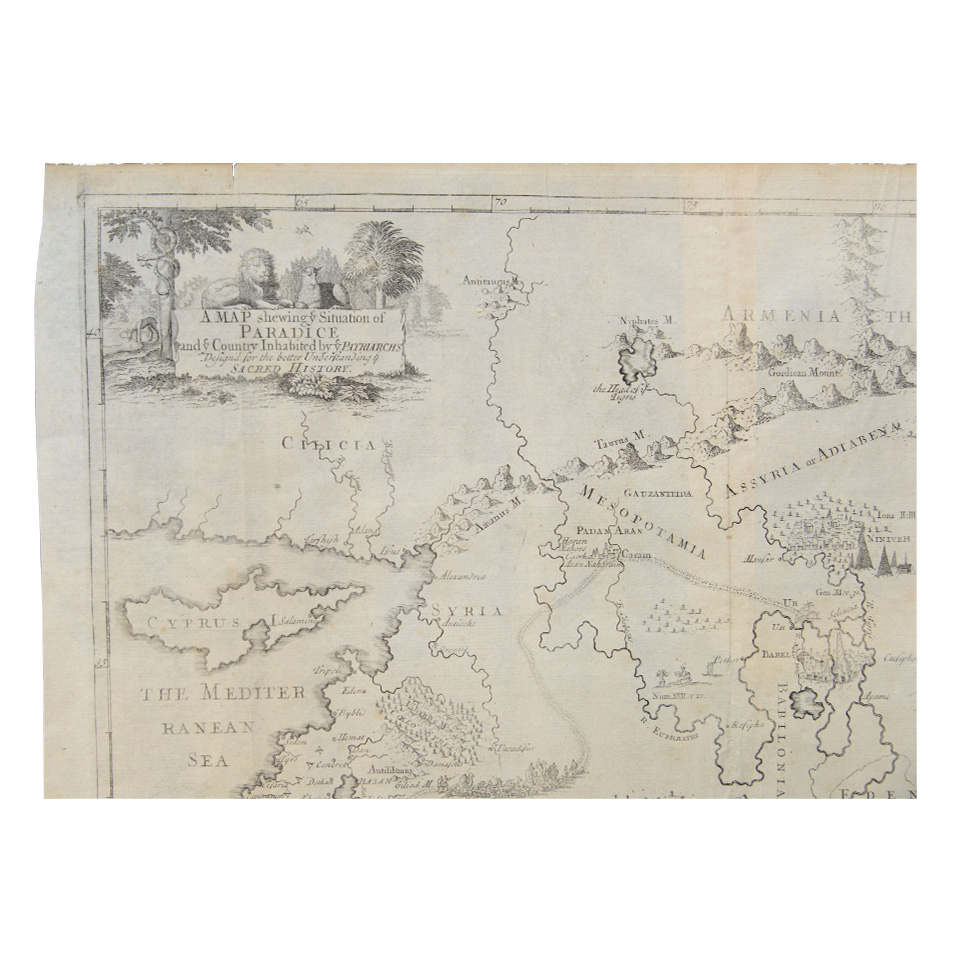
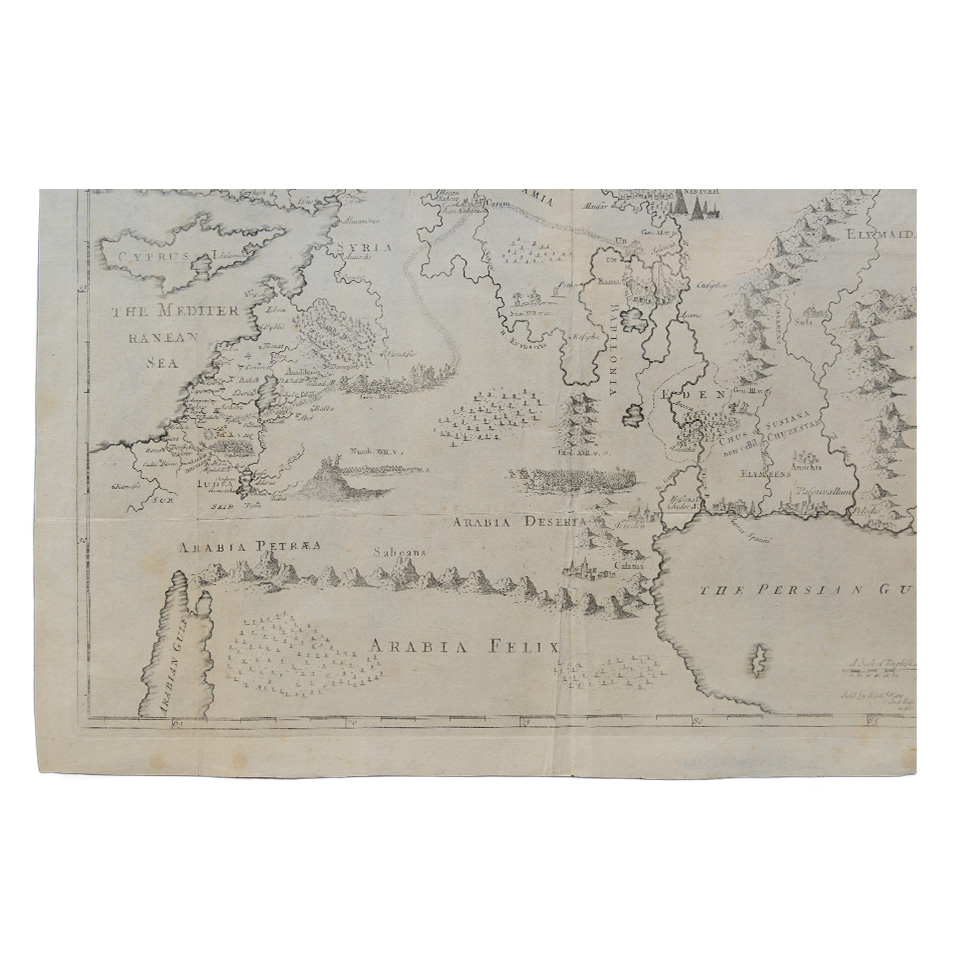
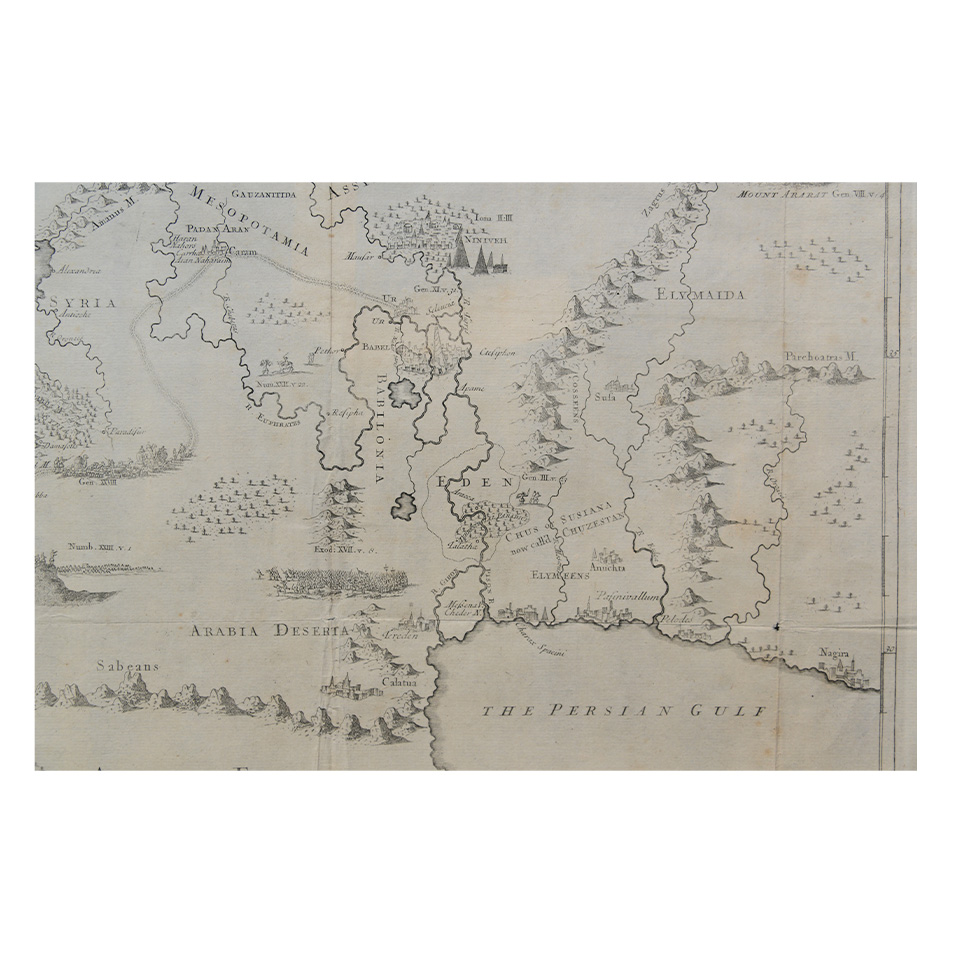
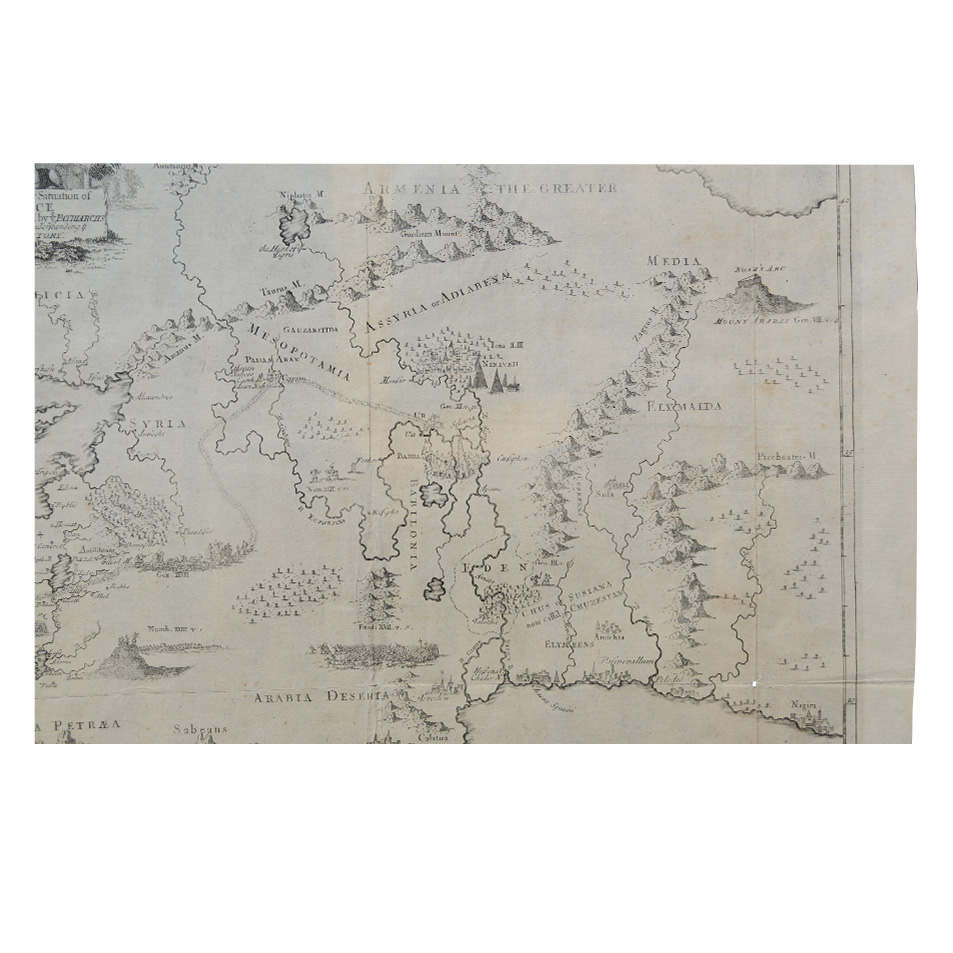
Arabia – Cyprus – The Holy Land – The Garden Of Eden – The Arabian Peninsula – Babylon – A Map Shewing Ye Situation Of Paradice And Ye Country Inhabited By Ye Patriarchs
Cartographer: Ware, Richard & Taylor, William
Place: London, UK
Price: £175 including postage in the UK
Publication Date: c.1725
Edition: Not stated
Sheet Size: 48.3cm x 38.8cm
Condition: Good
Condition:
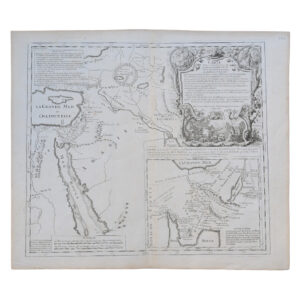
Original copper engraved map. Date: c.1725. Sheet size: 48.3cm x 38.8cm. A map of ‘Paradise’, showing the Middle East as far as Persia. Paradise is located to the south of Mesopotania. The map is scattered with Biblical illustrations and also shows the route taken by Abraham from Ur to Canaan. Niniveh and Babel are shown as big cities and Noah’s Ark is shown atop Mount Ararat. The tower of Babel is clearly visible. ‘Sold by Rich’d Ware and Wil’ Taylor at the Ship in Paternoster Row’, other names erased. Published in ‘Sacred Geography contained in six maps’ and added to The Holy Bible, Oxford by John Baskett. Uncoloured. Signs of old folds, with small holes and minor wear to intersections. Short closed tears to the margins. Some soiling to the margins, minor spotting to map and age-toning to the edges of the paper, otherwise a good example. Scarce.
Paradise And The Garden Of Eden: A Brief Overview
Paradise and the Garden of Eden are among the most influential and enduring concepts in religious, literary, and cultural history. Rooted in the opening chapters of the Book of Genesis, they function simultaneously as a place, a state of being, and a theological idea. Over time, Eden has come to represent innocence, divine intimacy, lost perfection, and the human longing for restoration.
While often treated as synonymous, “Paradise” and “the Garden of Eden” have distinct origins and evolving meanings.
- The Garden of Eden in Genesis
Biblical Location and Description
The Garden of Eden appears in Genesis 2–3 as a divinely planted garden in which the first humans, Adam and Eve, live in direct relationship with God.
Key features include:
- A fertile, enclosed garden
- The Tree of Life
- The Tree of the Knowledge of Good and Evil
- Four rivers flowing from Eden: Pishon, Gihon, Tigris, and Euphrates
The setting evokes abundance, harmony, and order rather than wilderness or labour.
Eden as Sacred Space
Eden is not merely agricultural land; it functions as a sacred sanctuary:
- God walks in the garden
- Humanity enjoys unmediated divine presence
- There is no death, shame, or moral anxiety
In later interpretation, Eden is often compared to a proto-temple, anticipating sacred spaces in Israelite worship.
- The Meaning of “Eden”
The name Eden is traditionally associated with ideas of:
- Delight
- Pleasure
- Abundance
Linguistically and conceptually, Eden signifies a place of ideal provision and joy, rather than moral testing alone. Humanity’s role is custodial rather than exploitative.
- The Fall and the Loss of Eden
The Act of Disobedience
Adam and Eve’s eating of the forbidden fruit introduces:
- Moral self-awareness
- Shame
- Alienation
- Mortality
This moment, often called the Fall, marks a decisive rupture in the human condition.
Expulsion from the Garden
After the transgression:
- Humanity is expelled from Eden
- Cherubim guard the way to the Tree of Life
- Labour, pain, and death enter human experience
The loss of Eden is not only spatial but existential: Paradise becomes unreachable by human effort.
- Paradise: From Garden to Concept
The Term “Paradise”
The word Paradise originates from an ancient term meaning enclosed garden or royal park. Over time, it became associated with Eden and then expanded in meaning.
In later Jewish and Christian tradition, Paradise refers to:
- The original state of harmony
- A heavenly realm
- The dwelling place of the righteous after death
Thus, Paradise is both retrospective (what was lost) and prospective (what may be restored).
- Eden and Ancient Near Eastern Context
The Garden of Eden shares features with ancient Near Eastern imagery:
- Sacred gardens associated with gods and kings
- Rivers as symbols of life and order
- Trees as sources of divine power
However, the biblical account is distinctive in its emphasis on:
- A single, moral God
- Human responsibility and choice
- Ethical rather than mythic explanation for suffering
Eden is not lost through divine conflict but through human disobedience.
- Eden in Jewish Thought
In Jewish tradition:
- Eden is sometimes understood as a historical place
- Sometimes as a spiritual realm
- Often as a symbol of original righteousness
Later texts speak of:
- A Garden of Eden above (heavenly)
- A Garden of Eden below (earthly)
The focus is less on inherited guilt and more on human responsibility and repentance.
- Eden and Paradise in Christian Theology
Christian interpretation places Eden at the beginning of a redemptive arc:
- Adam’s disobedience introduces sin and death
- Christ is presented as the “new Adam”
- Redemption aims at restoring what was lost
Paradise thus becomes:
- The goal of salvation
- A return to divine communion
- Fulfilment rather than mere reversal
Imagery of the Tree of Life reappears in the Book of Revelation, linking Eden with the end of history.
- Paradise as a Moral and Psychological Symbol
Beyond theology, Eden functions symbolically as:
- Innocence before experience
- Harmony before division
- Unity before self-consciousness
In literature and philosophy, the loss of Paradise is often read as:
- The cost of knowledge
- The beginning of maturity
- The tragic necessity of growth
Eden becomes less a place to be recovered physically and more a condition to be reimagined ethically or spiritually.
- Eden in Art, Literature, and Culture
Eden has inspired:
- Medieval and Renaissance art
- Epic poetry, notably Paradise Lost
- Romantic and modern reflections on nature and loss
Artists and writers repeatedly return to Eden to explore:
- The tension between freedom and obedience
- The pain of exile
- The hope of renewal
Paradise remains a powerful imaginative framework for thinking about what humanity was, is, and might become.
- Eden and the Idea of Restoration
Across traditions, Eden is rarely understood as irretrievably lost:
- It is remembered to instruct
- Longed for to inspire
- Reinterpreted to guide moral life
Whether as heaven, a redeemed world, or inner harmony, Paradise becomes a vision of restored order rather than mere nostalgia.
Conclusion
The Garden of Eden and the idea of Paradise occupy a foundational place in religious and cultural thought. Eden represents humanity’s original harmony with God, nature, and itself; Paradise represents both that lost state and the hope of restoration. Together, they form a narrative framework through which questions of freedom, responsibility, suffering, and redemption are explored.
Rather than a simple myth of origins, Eden is a permanent point of reference—a story through which humanity reflects on loss, longing, and the enduring desire for a world made whole again.
Why buy from us?
At Hornseys, we are committed to offering items that meet the highest standards of quality and authenticity. Our collection is meticulously curated to ensure that each item is a valuable and authentic piece of history. Here’s what sets us apart:
- Authenticity and Provenance: Every item is researched, collated, and verified for authenticity.
- Expert Curation: Each item is selected with a keen eye for significance, condition, and rarity, ensuring a collection that is both diverse and distinguished.
- Customer Satisfaction: We strive to provide an exceptional customer experience, from detailed descriptions and provenance to secure and prompt delivery of your purchase.
- Returns Policy: We offer an unconditional guarantee on every item. If you wish to make a return, items may be sent back to us within fourteen days of receipt for any reason. We request advance notification of returns, and items must be returned in the same condition as sent for a full refund.
Explore Our Collection:
Visit Hornseys to explore our fine collection of rare and signed books, maps, artwork and objects. Whether you are an avid collector or looking for a special gift, our selection offers something truly unique. Located in the picturesque Yorkshire Dales, our Ripon gallery has been a haven for book lovers, art enthusiasts, and collectors since 1976.
Thank you for looking.