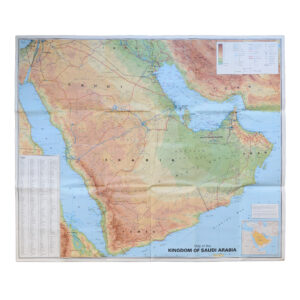
Arabia – The Middle East – Acre – The Arabian Peninsula – Civitas Acon Sive Ptolomaida – 1630
Cartographer: Picart, Jean
Place: London, UK
Price: £275 including postage in the UK
Publication Date: c.1630
Edition: Not stated
Sheet Size: 40.3cm x 36.4cm
Condition: Near fine
Condition:
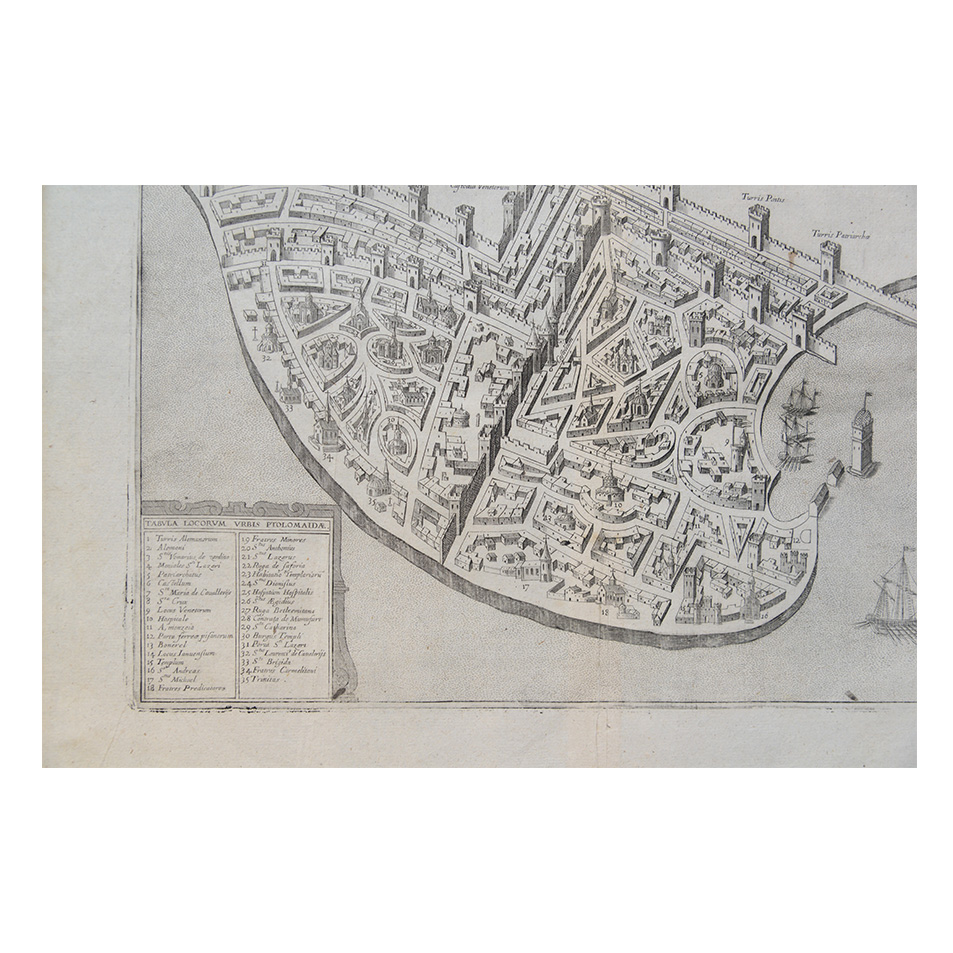
Original copper engraved map. Date: c.1630. Sheet size: 40.3cm x 36.4cm. A plan of Acre, based upon the Vesconte/Sanuto plan which shows the extensive fortifications illustrating a period when the City was under the control of the Knights of St. John. A numbered key bottom left identifies the significant landmarks. Acre or Akko is one of the oldest continuously inhabited cities in the World. The history dates back to Pharaoh Thutmose III (1504-1450 BC). It was one of the major ports in the Middle East along with Alexandria and Constantinople. It later came under the control of Alexander the Great after his conquest of 332 BC. Then seized by Egyptian King Ptolemy II, who renamed the City Ptolemais in the 2nd Century BC. The Muslim’s conquered the City in the 7th Century AD and In 1104, the City was conquered by the Knights of Malta renaming it St. Jean d’Acre. In 1291, the Mamluks invaded and destroyed the City, killing all the remaining Crusaders, ending its ancient history. Engraved by Jean-Félix Picard (1620 1682) a French astronomer and priest. Uncoloured. Very light age-toning to the edges of the paper, otherwise a near fine example. Scarce.
The City Of Acre: A Brief Overview
The city of Acre, situated on the eastern Mediterranean coast of present-day northern Israel, is one of the oldest continuously inhabited cities in the world. Its strategic harbour, fertile hinterland, and position at the crossroads of trade routes linking Egypt, the Levant, Mesopotamia, and the Mediterranean made it a city of enduring political, commercial, and military importance. Across more than four millennia, Acre has been ruled by successive empires, each leaving deep physical and cultural layers that still shape the city today.
- Ancient Origins (Bronze Age)
Acre’s origins extend back to the Early Bronze Age (third millennium BC). Archaeological evidence indicates that it developed as a Canaanite city-state, benefitting from:
- A natural harbour
- Access to inland trade routes
- Agricultural productivity in the surrounding plains
In ancient sources, Acre appears under names such as Akko or Akka. It was integrated into the network of Levantine coastal cities that connected Egypt with Syria and Mesopotamia.
- Egyptian and Canaanite Periods
During the Middle and Late Bronze Ages, Acre came under Egyptian influence. It is mentioned in:
- Egyptian texts
- The Amarna letters, where local rulers corresponded with the Pharaoh
At this stage, Acre functioned as:
- A fortified port
- A regional administrative centre
- A node in long-distance trade
Despite Egyptian oversight, the city retained local Canaanite leadership and culture.
- Israelite and Phoenician Context (Iron Age)
In the biblical period, Acre lay on the margins of Israelite political control:
- It is mentioned in the Hebrew Bible but not fully incorporated into the Israelite kingdoms
- The city remained largely Phoenician in culture, aligned with coastal trading networks
Under Phoenician influence, Acre continued to thrive as a maritime centre, engaging in commerce across the Mediterranean.
- Persian and Hellenistic Rule
Persian Period
Under the Achaemenid Persian Empire (6th–4th centuries BC), Acre became a key administrative and naval base:
- It supported Persian operations in the eastern Mediterranean
- Its harbour was strategically important for imperial logistics
Hellenistic Period
After Alexander the Great’s conquest, Acre passed through Ptolemaic and Seleucid control. It was renamed Ptolemais, reflecting its integration into the Hellenistic world.
During this period:
- Greek culture and institutions were introduced
- The city expanded and prospered
- Acre became one of the principal cities of the region
- Roman and Byzantine Acre
Under Roman rule, Acre (Ptolemais):
- Functioned as a provincial city
- Benefited from Roman infrastructure, including roads and public buildings
It served as a gateway between the coast and inland Galilee.
During the Byzantine period, Christianity spread widely:
- Acre became a bishopric
- Churches and religious institutions were established
- The city retained commercial importance
- Early Islamic Period
In the 7th century, Acre was captured by Muslim forces during the Islamic conquests. Under successive Islamic dynasties:
- The city remained a major port
- Shipbuilding and trade flourished
- Acre became an important naval base for the eastern Mediterranean
Islamic rule integrated Acre into a vast commercial world stretching from Spain to Central Asia.
- Crusader Acre: Capital of the Latin Kingdom
Acre reached the height of its medieval prominence during the Crusader period.
First Crusader Conquest
Captured in 1104, Acre became:
- The principal port of the Kingdom of Jerusalem
- A vital link between Europe and the Crusader states
Capital of the Kingdom
After Jerusalem fell in 1187, Acre became the capital of the Kingdom of Jerusalem. At its peak, it was:
- One of the largest cities in the eastern Mediterranean
- Home to diverse populations: Europeans, Muslims, Jews, Eastern Christians, merchants from Italy and beyond
- A centre of trade, finance, and religious life
Massive fortifications, churches, and quarters for military orders (Templars, Hospitallers, Teutonic Knights) were constructed.
Fall of Acre (1291)
In 1291, Acre fell to the Mamluks after a brutal siege. This event:
- Marked the end of Crusader rule in the Holy Land
- Resulted in widespread destruction
- Initiated a long period of decline
- Mamluk Period
Under Mamluk rule:
- Acre was deliberately reduced in importance to prevent future Crusader return
- The harbour silted up
- Population declined significantly
For several centuries, Acre existed as a modest coastal town, overshadowed by other regional centres.
- Ottoman Revival
Acre’s fortunes revived dramatically under Ottoman rule, especially in the 18th century.
Ahmad al-Jazzar
The most significant Ottoman-era figure was Ahmad al-Jazzar, the semi-autonomous ruler of Acre. Under his rule:
- The city was rebuilt and heavily fortified
- Public buildings, mosques, and markets were constructed
- Acre became the capital of a powerful regional domain
Napoleon’s Siege
In 1799, Acre successfully resisted a siege by Napoleon Bonaparte, an event of major symbolic importance that halted French ambitions in the eastern Mediterranean.
- Nineteenth and Early Twentieth Centuries
During the 19th century:
- Acre gradually declined as Haifa developed into a modern port
- It remained an administrative and military centre
- Its population included Muslims, Christians, Jews, and others
Under British Mandatory rule after the First World War, Acre:
- Served as a prison and administrative centre
- Became a focal point in regional political tensions
- Modern Period
Following the events of 1948, Acre became part of the State of Israel. In the modern era:
- The old city has been preserved as a historic site
- Acre is recognised as a UNESCO World Heritage Site for its Crusader and Ottoman remains
- The city remains ethnically and culturally diverse
Today, Acre is valued not only as a living city but as a unique historical palimpsest, where layers of Canaanite, Roman, Islamic, Crusader, and Ottoman history coexist.
Conclusion
The history of Acre is a story of strategic geography, resilience, and reinvention. Few cities have experienced such repeated cycles of rise, destruction, and renewal. From Bronze Age port to Crusader capital, from Ottoman stronghold to modern heritage city, Acre stands as one of the Mediterranean world’s most historically significant urban centres. Its enduring importance lies in its ability to absorb and reflect the civilisations that have passed through it, leaving a city shaped by continuity as much as by change.
Why buy from us?
At Hornseys, we are committed to offering items that meet the highest standards of quality and authenticity. Our collection is meticulously curated to ensure that each item is a valuable and authentic piece of history. Here’s what sets us apart:
- Authenticity and Provenance: Every item is researched, collated, and verified for authenticity.
- Expert Curation: Each item is selected with a keen eye for significance, condition, and rarity, ensuring a collection that is both diverse and distinguished.
- Customer Satisfaction: We strive to provide an exceptional customer experience, from detailed descriptions and provenance to secure and prompt delivery of your purchase.
- Returns Policy: We offer an unconditional guarantee on every item. If you wish to make a return, items may be sent back to us within fourteen days of receipt for any reason. We request advance notification of returns, and items must be returned in the same condition as sent for a full refund.
Explore Our Collection:
Visit Hornseys to explore our fine collection of rare and signed books, maps, artwork and objects. Whether you are an avid collector or looking for a special gift, our selection offers something truly unique. Located in the picturesque Yorkshire Dales, our Ripon gallery has been a haven for book lovers, art enthusiasts, and collectors since 1976.
Thank you for looking.