Early Latin Prayer Book – Prayers After Mass – St Augustine, St Thomas Aquinas & the Blessed Virgin Mary – Original Red-and-Black Leaf – c.1500–1520
Description
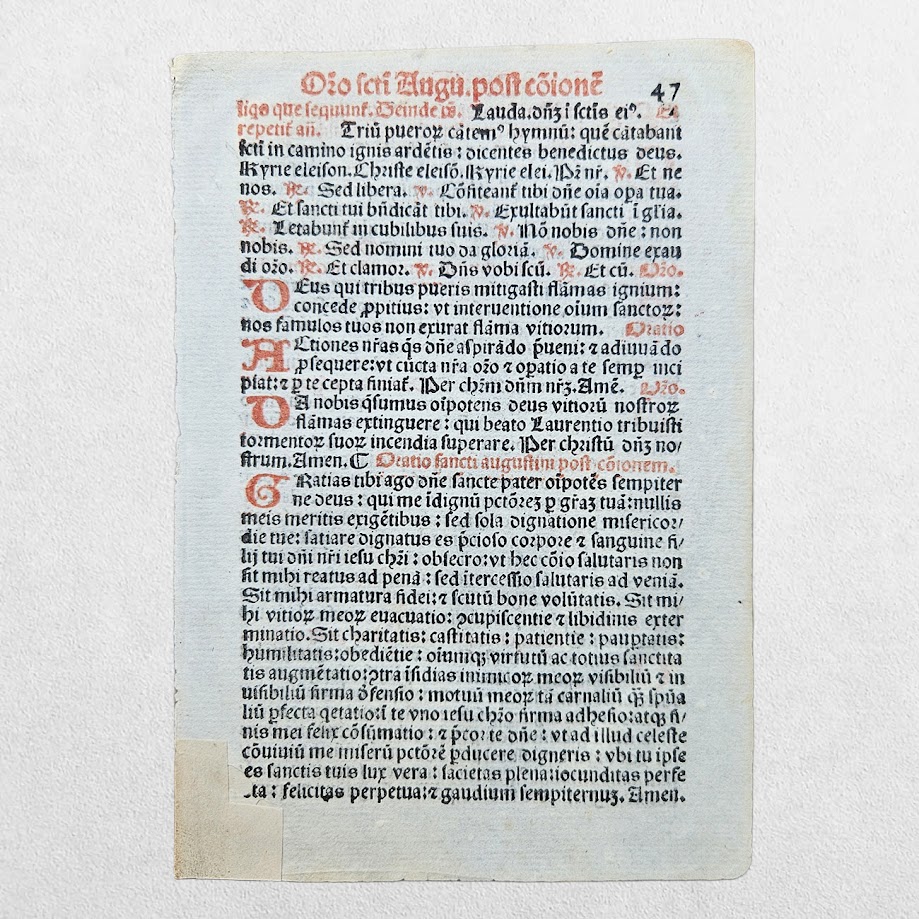
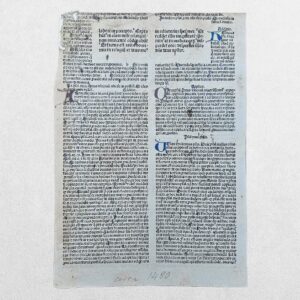
An attractive early sixteenth-century Latin devotional and liturgical leaf, printed in red and black in a compact Gothic type and containing a sequence of prayers and thanksgivings associated with the celebration of Mass. The double-sided leaf measures approximately 10 x 14.4 cm and is numbered 47.
Although the precise edition from which this detached leaf originated has not yet been securely identified, its contents can be identified in considerable detail. The texts belong to the long medieval and early-modern tradition of prayers said by a priest following Mass and Holy Communion, including the Canticum trium puerorum, prayers traditionally attributed to St Augustine, and prayers for deficiencies or faults committed during the Mass and Divine Office. Comparable collections of sacerdotal prayers preserve essentially the same sequence of post-Mass material.
The leaf is particularly appealing typographically. Principal headings, liturgical directions, initials and selected responses are printed in red, contrasting strongly with the dense black Gothic letterpress. This is two-colour printing rather than manuscript rubrication: the red elements formed part of the original printing process and required a separate impression, giving the page much greater visual interest than an ordinary monochrome devotional leaf.
The Canticum Trium Puerorum
One side continues the traditional thanksgiving after Mass based upon the Song of the Three Holy Children. Visible near the head are the words:
“Trium puerorum … hymnum”
followed by the familiar liturgical sequence of Kyrie eleison, the Lord’s Prayer and versicles.
The page then contains the collect:
“Deus qui tribus pueris mitigasti flammas ignium…”
— a prayer asking that, just as God moderated the flames for the Three Children, his servants might not be consumed by the flames of vice.
This prayer remains part of the traditional sequence of thanksgiving after Mass, together with “Actiones nostras, quaesumus Domine…” and “Da nobis quaesumus Domine vitiorum nostrorum flammas extinguere…”, all three of which are visible on the present leaf. The complete traditional sequence is independently preserved in liturgical prayer sources.
The reference is to the biblical account of the Three Children in the fiery furnace, and its use after Mass provided the celebrant with a powerful image of divine protection and spiritual purification.
Thanksgiving After Communion
The lower part of the same page introduces another substantial prayer beginning:
“Gratias tibi ago o sancte pater omnipotens sempiterne deus…”
— “I give thanks to thee, O holy Father, almighty and eternal God…”
The prayer thanks God for having fed the celebrant with the sacred Body and Blood of Christ and petitions that Communion should bring salvation rather than judgement, strengthen faith and extinguish vice.
In later Catholic devotional tradition this prayer is particularly associated with St Thomas Aquinas and continues to be printed among prayers after Mass. Early printed prayer collections, however, could transmit these devotional texts under differing attributions, so the wording and rubric of the present leaf should be allowed to speak for themselves rather than imposing a later attribution where the original source has not yet been identified.
“Orationes” – Prayers for Defects in the Mass and Divine Office
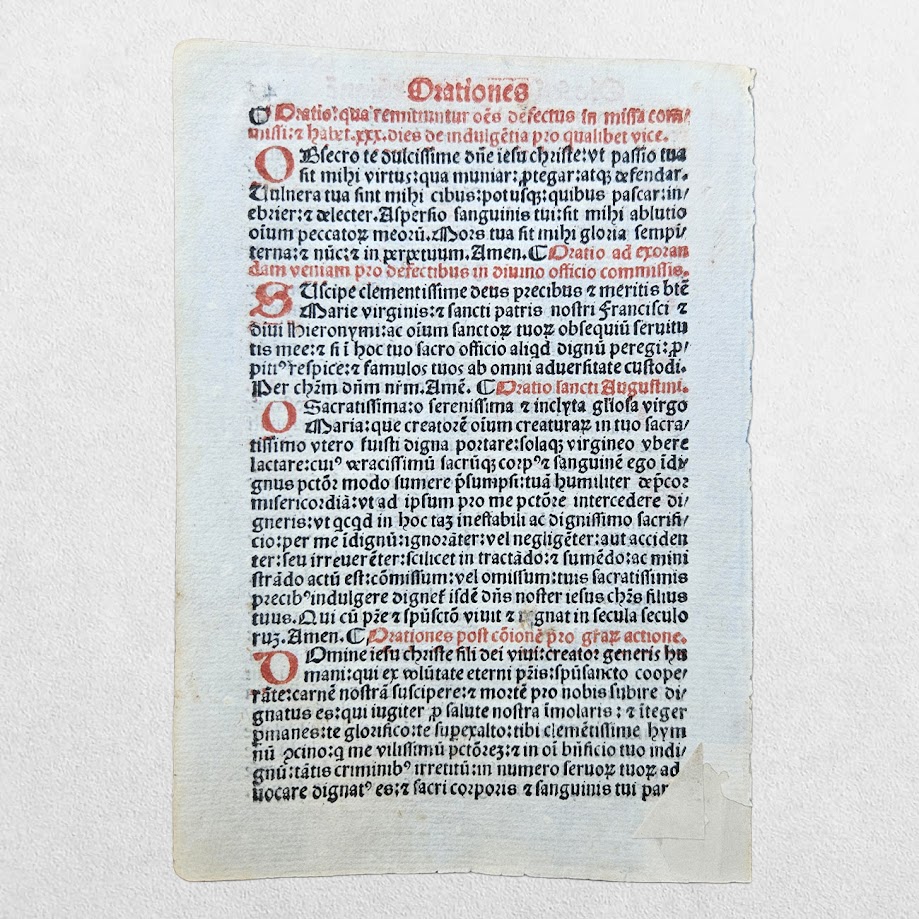
The reverse is headed prominently in red:
“Orationes”
and contains a particularly interesting series of prayers concerned with defects or shortcomings in liturgical worship.
The first rubric refers to:
“defectus in missa commissi”
— faults or deficiencies committed in the Mass.
Such prayers belong to the long sacerdotal tradition in which a priest prayed for forgiveness for failures of attention, devotion, pronunciation or performance associated with celebrating the liturgy.
Another rubric refers explicitly to:
“defectibus in divino officio commissis”
— defects committed in the Divine Office.
The existence of specialised prayers pro defectibus in divino officio commissis is documented in medieval and early-modern liturgical ordinaries and priestly manuals.
This makes the leaf particularly interesting for the history of priestly devotion and liturgical practice: it concerns not simply the formal words of the Mass, but the celebrant’s personal preparation, thanksgiving and examination of his own performance of the liturgy.
Prayer Attributed to St Augustine and the Virgin Mary
A red rubric on the reverse introduces:
“Oratio sancti Augustini”
followed by the striking invocation:
“Sacratissima: o serenissima et inclyta gloriosa virgo Maria…”
This is a recognised traditional prayer to the Blessed Virgin after Holy Communion, long attributed to St Augustine. The surviving Latin tradition begins “O sacratissima, o serenissima et inclyta gloriosa Virgo Maria…” and addresses Mary as the Virgin who bore the Creator in her womb.
Its appearance here is significant because it confirms the devotional purpose of this section of the book: these are intimate post-Communion prayers intended for the celebrant’s private use rather than ordinary congregational texts.
Printing and Dating
The exact volume has not yet been conclusively identified, and no printer, city or exact year should therefore be asserted without further bibliographical evidence.
On typographical grounds — particularly the compact Gothic type, the extensive use of contractions, the red-and-black printing, the small devotional format and the arrangement of post-Mass prayers — I would describe the leaf provisionally as:
Continental European Latin liturgical/devotional printing, probably c.1500–1520.
That dating should be treated as an informed bibliographical estimate rather than a proven imprint.
The underlying prayers are considerably older. The post-Mass sequence involving the Trium puerorum, Deus qui tribus pueris, Actiones nostras and associated collects is deeply rooted in medieval sacerdotal practice and continued into later Roman Catholic liturgical books.
Condition
Good condition overall for an early sixteenth-century devotional leaf.
There is general age-toning, slight marginal browning and occasional light spotting and surface marking. The lower portion shows old paper reinforcement and small historical repairs, particularly towards the margins. There is a small repaired or strengthened area towards the lower outer corner on the Orationes side.
The principal printed areas remain substantially complete and highly legible. Importantly, the red and black printing remains strong and vivid, with the rubricated headings and initials providing considerable visual appeal.
The sheet has survived with generous enough margins to retain its original page character.
Please study the photographs carefully as they form an integral part of the condition description.
Work
Unidentified Latin sacerdotal / liturgical prayer book or manual.
Contents
Post-Mass thanksgiving and devotional prayers, including:
- Canticum Trium Puerorum
- Deus qui tribus pueris mitigasti flammas ignium
- Actiones nostras, quaesumus Domine
- Da nobis quaesumus Domine vitiorum nostrorum flammas extinguere
- post-Communion thanksgiving beginning Gratias tibi ago…
- prayers concerning defects committed during Mass
- prayer concerning defects committed in the Divine Office
- prayer attributed to St Augustine beginning Sacratissima, o serenissima…
Date: Probably c.1500–1520
Exact edition presently unidentified.
Page: 47
Size: Approximately 10 x 14.4 cm
Language: Latin.
Printing: Original letterpress in Gothic type, printed in red and black.
Subject: Catholic liturgy; Mass; Holy Communion; sacerdotal devotion; prayers after Mass; St Augustine; St Thomas Aquinas; Blessed Virgin Mary; Divine Office; early printing.
Authentication & Research
This leaf has been handled, inspected and catalogued in-house at our Ripon gallery. Its individual prayers have been identified through their surviving Latin incipits and compared with liturgical and scholarly sources. The Trium puerorum sequence and associated collects remain documented among traditional post-Mass prayers, while the Sacratissima, o serenissima prayer survives specifically within the tradition of post-Communion prayers attributed to St Augustine.
No unsupported printer or exact publication date has been assigned.
Why buy from us?
At Hornseys, we are committed to offering items that meet the highest standards of quality and authenticity. Our book collection is meticulously curated to ensure that each edition is a valuable and authentic piece of bibliographical history. Here’s what sets us apart:
- Authenticity and Provenance: Every book is researched, collated, and verified for authenticity.
- Expert Curation: Each book is selected with a keen eye for significance, condition, and rarity, ensuring a collection that is both diverse and distinguished.
- Customer Satisfaction: We strive to provide an exceptional customer experience, from detailed descriptions and provenance to secure and prompt delivery of your purchase.
- Returns Policy: We offer an unconditional guarantee on every item. If you wish to make a return, books may be sent back to us within fourteen days of receipt for any reason. We request advance notification of returns, and books must be returned in the same condition as sent for a full refund.
Explore Our Collection:
Visit Hornseys to explore our fine collection of rare and signed books. Whether you are an avid collector or looking for a special gift, our selection offers something truly unique. Located in the picturesque Yorkshire Dales, our Ripon gallery has been a haven for book lovers, art enthusiasts, and collectors since 1976.