Field-Marshal Sir William Slim – Unofficial History – First Edition, 1959 – Military Memoirs, Mesopotamia, India, Persia and the Second World War
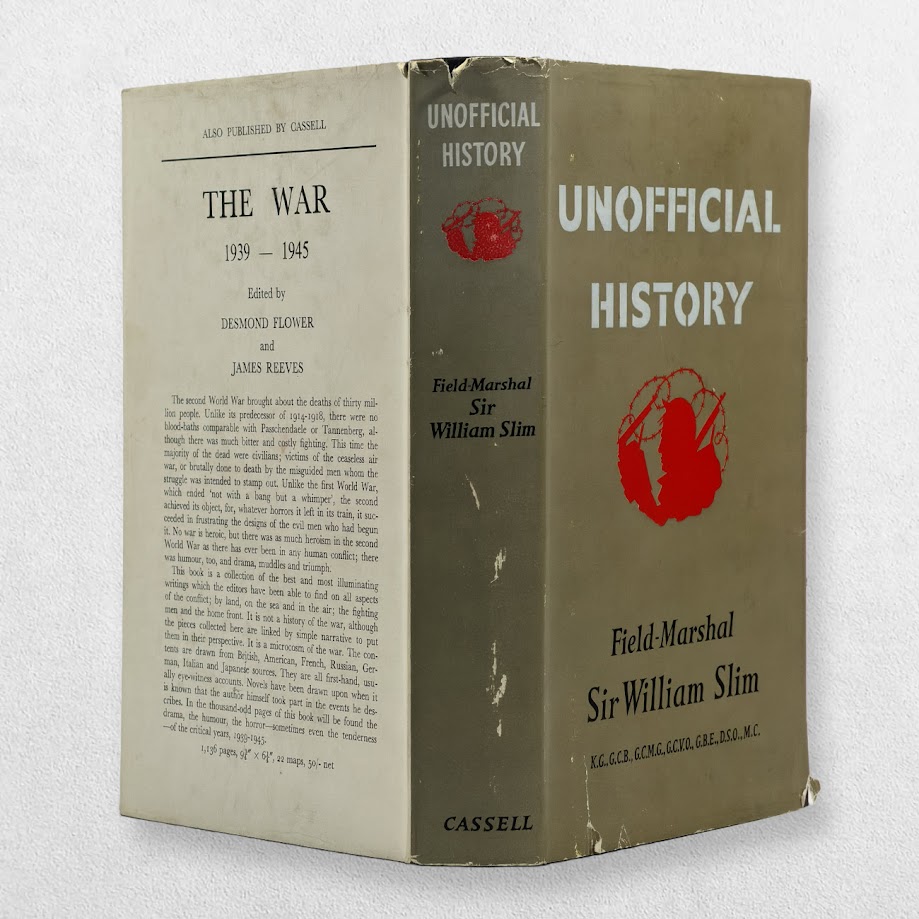
SLIM, FIELD-MARSHAL SIR WILLIAM. UNOFFICIAL HISTORY. FIRST EDITION, 1959. AN IMPORTANT COLLECTION OF FIRST-HAND MILITARY REMINISCENCES BY THE CELEBRATED COMMANDER OF THE BRITISH FOURTEENTH ARMY IN BURMA, COVERING THE FIRST WORLD WAR, MESOPOTAMIA, INDIA, THE NORTH-WEST FRONTIER, PERSIA AND THE SECOND WORLD WAR. ORIGINAL CLOTH AND DUSTWRAPPER.
Author: Field-Marshal Sir William Joseph Slim (1891–1970), later 1st Viscount Slim.
Publisher: Cassell & Company Ltd., London, England.
Date: 1959.
Edition: First edition.
Format: Octavo. Original publisher’s black cloth binding, lettered in gilt to the spine, with the original printed dustwrapper.
Pagination: x, 242 pages.
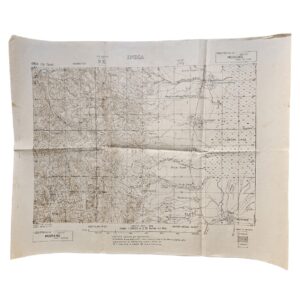
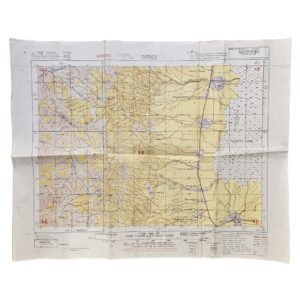
Illustrations: Three folding maps.
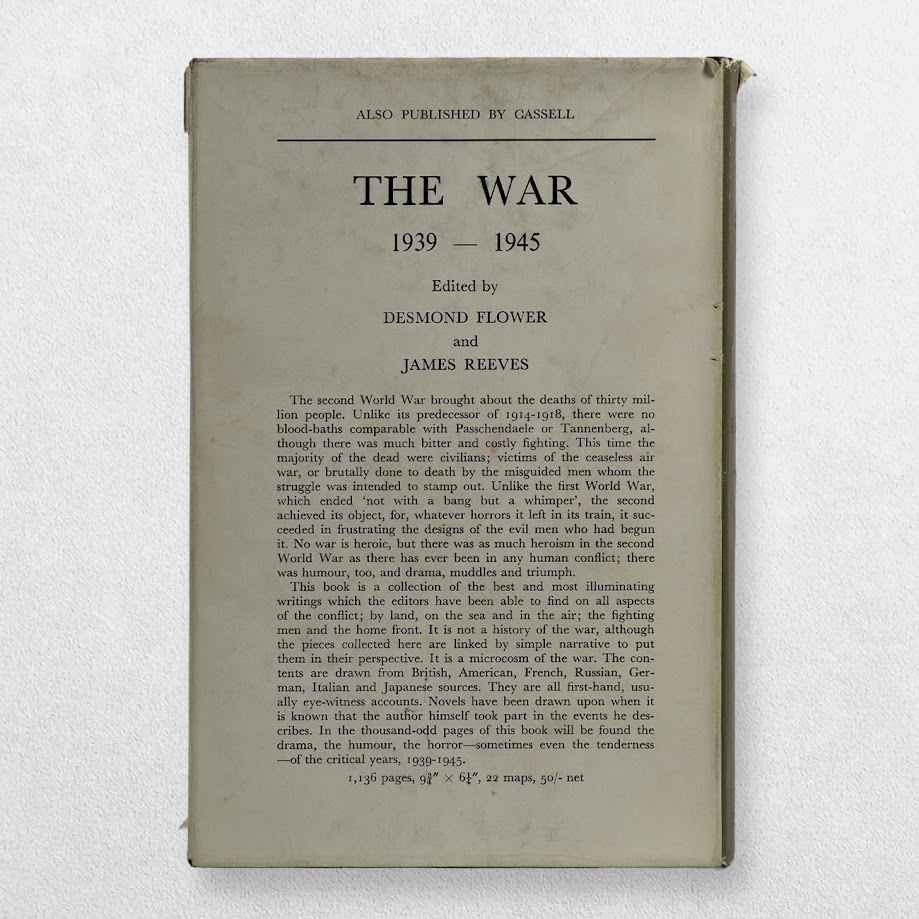
Condition: Near fine in a very good original dustwrapper, slightly creased, nicked, faded, marked and rubbed, with a few short closed tears. The pages are exceptionally clean.
Stock Code: 004237.
Location: Bookroom.
Description
An attractive first edition of Unofficial History, Field-Marshal Sir William Slim’s highly regarded collection of military reminiscences, published by Cassell in London in 1959. Best remembered as the commander of the British Fourteenth Army during the Burma Campaign of the Second World War, Slim was one of the most accomplished and respected British military leaders of the twentieth century. His earlier book, Defeat Into Victory (1956), established his reputation as an outstanding military writer. In Unofficial History, he turns his attention to a different aspect of his career, recounting the smaller campaigns, engagements and personal experiences that rarely receive detailed attention in official military histories.
The book provides a fascinating account of military service in Mesopotamia during the First World War, the British Indian Army, the North-West Frontier, the Middle East, Persia and other theatres of operations. Slim’s narrative combines detailed military observation with personal recollection, humour, insight into the character of soldiers and reflections upon the difficulties of command. Unlike conventional histories concerned primarily with grand strategy and major battles, Unofficial History examines the smaller operations and individual decisions that collectively shaped the experience of professional soldiering. These episodes illuminate Slim’s development as a commander and provide an unusually personal perspective upon British and Indian military service during the first half of the twentieth century.
Unofficial History: The Lesser-Known Campaigns of a Great Soldier
The title Unofficial History reflects Slim’s belief that military history is not adequately represented by accounts of major battles, famous generals and decisive campaigns alone. The experiences of ordinary officers and soldiers, the conduct of smaller engagements and the practical challenges of military service can be just as revealing as the great events upon which conventional histories concentrate. Drawing upon his long military career, Slim describes a succession of experiences in very different geographical and political circumstances.
These include operations undertaken during the First World War, military service in British India and the North-West Frontier, and engagements in the Middle East during the Second World War. The book is particularly valuable for its descriptions of the realities of command. Slim examines the difficulties of interpreting imperfect intelligence, maintaining communications, moving troops through unfamiliar terrain and making decisions under pressure. He also displays considerable appreciation of the abilities and limitations of individual soldiers. His accounts demonstrate the qualities that subsequently characterised his leadership of the Fourteenth Army: practical judgement, attention to morale, adaptability and a strong understanding of the men under his command. The result is an absorbing series of recollections that provides insight into the professional development of one of Britain’s finest soldiers.
Mesopotamia and the First World War
William Slim’s military career began during the First World War.
Following the outbreak of hostilities in 1914, he joined the Royal Warwickshire Regiment and subsequently served in the Middle East. He experienced active service during the Gallipoli Campaign and later in Mesopotamia, the region corresponding largely to modern Iraq. The Mesopotamian Campaign was an important but sometimes overlooked theatre of the First World War. British and Indian forces fought against Ottoman troops in difficult climatic and geographical conditions, with operations frequently complicated by inadequate transport, uncertain communications and the challenges of maintaining long supply routes. The campaign exposed soldiers to extreme heat, disease and the formidable logistical difficulties of operating along the great river systems of the Tigris and Euphrates.
Slim’s recollections provide valuable insight into the experience of officers serving in these conditions. His accounts illustrate the demanding nature of military operations conducted far from the principal European battlefields. The experience proved important in developing the qualities of endurance, tactical flexibility and practical leadership for which he later became celebrated.
India and the North-West Frontier
Following the First World War, Slim continued his military career in the British Indian Army. Service in India exposed him to a distinctive military environment in which British officers served alongside soldiers drawn from a wide range of communities and military traditions. The Indian Army played a central role in British imperial defence and participated in operations across the Middle East, Africa and Asia.
During the interwar years, operations on India’s North-West Frontier presented considerable challenges. The mountainous terrain, difficult communications and complex political circumstances required a form of warfare very different from the large-scale operations of the Western Front. Slim’s experiences contributed to his understanding of movement, supply, reconnaissance and the importance of adapting military tactics to the landscape.
His accounts are particularly interesting for the attention they give to individual soldiers and the relationships between officers and their men. These recollections also provide historical evidence of the British Indian Army and the military institutions associated with imperial rule. They should be read within the political context of British colonial control, including the resistance of local communities and the consequences of military operations along the frontier.
Persia and the Middle East During the Second World War
The book also includes accounts of military operations in the Middle East and Persia during the Second World War. These campaigns were important to Allied strategy because of the region’s oil resources, communications networks and geographical position between the Mediterranean, the Soviet Union and the Indian Ocean. In 1941, British and Soviet forces entered Iran in an operation intended to secure strategic communications and prevent the development of German influence. The campaign involved difficult movements across varied terrain and complex logistical arrangements.
Slim’s recollections illuminate the practical challenges faced by commanders and soldiers operating in these circumstances. His observations are particularly interesting because they concern operations that have often received considerably less attention than the major campaigns in North Africa and Europe.
The Burma Campaign and the Fourteenth Army
Although Unofficial History is not primarily a history of the Burma Campaign, Slim’s reputation as commander of the Fourteenth Army gives the book particular interest.
The Burma Campaign was among the longest and most demanding Allied campaigns of the Second World War. Following the Japanese conquest of Burma in 1942, Allied forces faced the formidable task of reorganising their armies and recovering lost territory. The campaign was conducted through mountainous and heavily forested regions, where monsoon rains and inadequate infrastructure created serious logistical difficulties.
Slim recognised that success depended upon developing effective supply systems, improving cooperation between different arms of the military and restoring the confidence of soldiers who had previously suffered defeat. His approach to command was characterised by practical leadership, close attention to morale and an ability to communicate clearly with officers and ordinary soldiers. The decisive victories at Imphal and Kohima in 1944, together with the subsequent advance into Burma, established the effectiveness of these methods.
Slim’s achievement was especially notable because the Fourteenth Army contained troops drawn from many countries, languages and military traditions. His understanding of the strengths and difficulties of a multinational army was fundamental to its success. The earlier experiences described in Unofficial History help explain how he developed the qualities that made him such an effective commander.
Defeat Into Victory and Unofficial History
Slim’s best-known book, Defeat Into Victory, was first published by Cassell in 1956. It provides a substantial account of the Burma Campaign and remains one of the classic military memoirs of the Second World War. In that work, Slim examined the defeat of British and Allied forces in Burma, the reconstruction of their fighting capabilities and the subsequent campaign that brought victory over Japan.
Unofficial History, published three years later, is an important companion volume. Rather than repeating the account of the Burma Campaign, it concentrates upon smaller engagements and experiences from other stages of his military career. It is therefore valuable in understanding the development of Slim’s leadership style and his practical philosophy of soldiering.
Where Defeat Into Victory demonstrates his ability to direct a major army in one of the most difficult campaigns of the Second World War, Unofficial History reveals the experiences through which his judgement and military character were formed.
Condition
Near fine in a very good original dustwrapper. The original publisher’s cloth binding is exceptionally clean and well preserved. The pages are very nice and clean throughout. The original dustwrapper is in very good condition, showing slight creasing, nicking, fading, marking and rubbing. There are a few short closed tears, together with minor wear around the edges and extremities, particularly near the spine ends and corners. An attractive, carefully preserved example of the first edition, with the original dustwrapper present. Now housed in an easily removable clear acetate cover.
Why Buy From Hornseys?
Established in 1976, Hornseys is an independent, family-run antiquarian bookshop and gallery in the historic cathedral city of Ripon, North Yorkshire. Celebrating our fiftieth year in 2026, we specialise in carefully selected first editions, military history, travel and exploration, original maps, photographs and historically significant books and ephemera.
Authenticity and Bibliographical Accuracy
Every book offered by Hornseys is individually examined and catalogued. We pay particular attention to edition and impression statements, original bindings, dustwrappers, illustrations and other significant bibliographical details. We distinguish first impressions from later printings and reprints, recognising the importance of accurate identification to collectors.
Historical Research
Our cataloguing seeks to explain both the historical importance of a book and its position within subsequent scholarship. For military memoirs and personal accounts, we distinguish the author’s first-hand testimony from later historical interpretations.
Detailed Condition Reporting
Every book is examined carefully before sale. We describe relevant condition issues, including foxing, dustwrapper wear, fading, tears and other defects, providing photographs of the actual item offered.
Established Since 1976
Hornseys has served collectors and readers for fifty years, building our reputation upon knowledgeable service, careful stock selection and accurate descriptions.
Free UK Tracked Delivery
We offer free tracked delivery throughout the United Kingdom, with secure packaging appropriate to the nature of each item.
Fourteen-Day Unconditional Returns
We offer a fourteen-day unconditional returns policy. Please notify us within fourteen days of receipt if you wish to return an item. Returned books must be received in the same condition in which they were supplied.
Visit Hornseys
Our bookshop and gallery is located at 3 Kirkgate, Ripon, North Yorkshire. We welcome enquiries from collectors of Second World War history, original military memoirs, the history of Singapore and Southeast Asia.
Hornseys – Established 1976. Celebrating Fifty Years of Specialist Antiquarian Bookselling.