Sebastian Münster – Modon, Argos and Epidaurus, Greece – Original Woodcut View from the 1568 French Cosmographie Universelle
Description
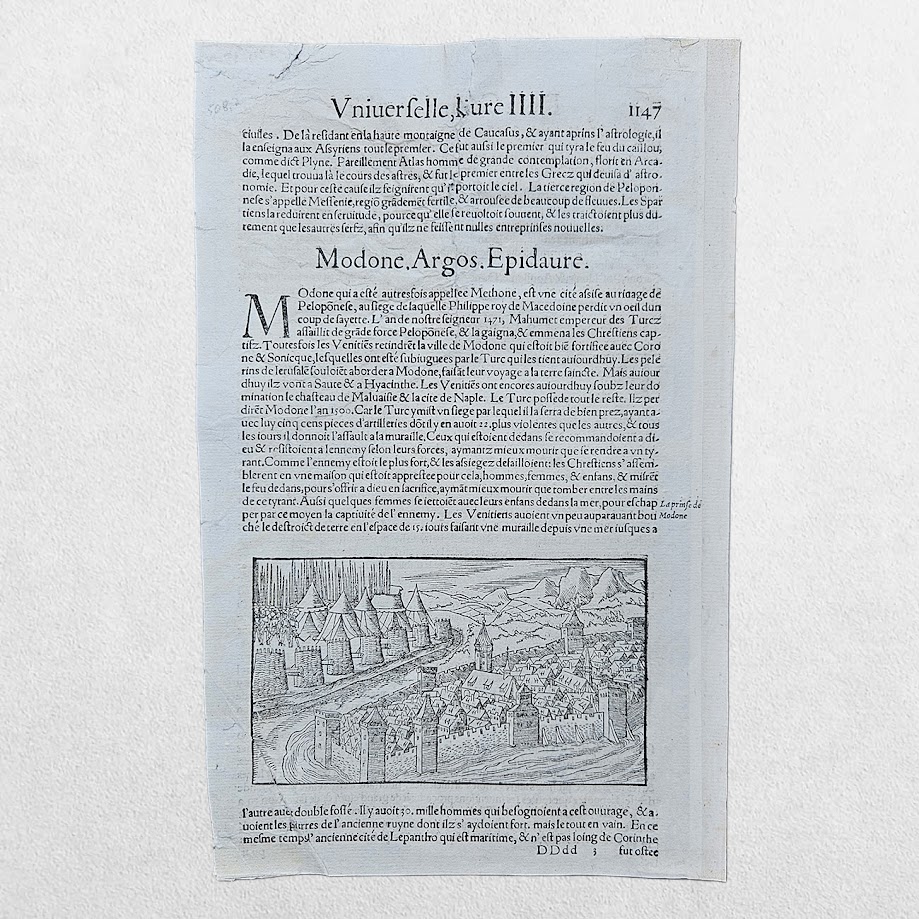
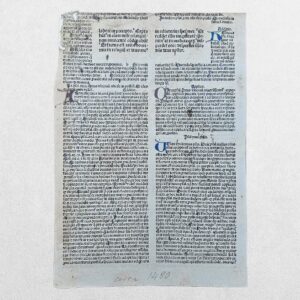
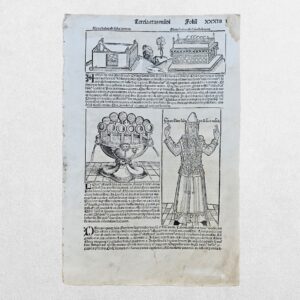
An original sixteenth-century illustrated leaf from the French edition of Sebastian Münster’s Cosmographie Universelle, Basel, 1568, comprising pp. 1147–1148 and devoted to Greece, the Peloponnese, Modon (Methoni), Argos and Epidaurus. Measuring approximately 18.2 x 29.1 cm, the double-sided leaf contains two woodcut illustrations together with extensive contemporary French geographical and historical text.
The attribution to the 1568 French edition is particularly secure. The Universitätsbibliothek Basel preserves a digitised copy catalogued as La Cosmographie universelle, contenant la situation de toutes les parties du monde, avec leurs proprietez & apartenances, Basel: Heinrich Petri, 1568. An independently catalogued example of this exact “Modone, Argos, Epidaure” leaf is also identified as coming from Münster’s French-language Cosmographie of 1568.
The principal side, numbered 1147 and headed “Universelle, Livre IIII.”, contains the substantial section:
“Modone, Argos, Epidaure.”
Below the text is an attractive rectangular woodcut view of Modon, modern Methoni, in the south-western Peloponnese. The fortified settlement occupies the foreground and is enclosed by substantial defensive walls and towers; beyond are densely packed buildings, rising ground and surrounding countryside, while an extensive encampment of peaked military tents occupies the left side of the composition.
The accompanying text discusses Modon’s position on the Peloponnesian coast and its turbulent history, including its relationship with Venice and its capture by the Ottomans. Münster’s image is not a measured topographical prospect in the later cartographic sense but a Renaissance geographical and historical representation, intended to convey both the fortified character of the place and the military events with which European readers associated it.
Modon — ancient Methone, modern Methoni — occupied a strategically important position on maritime routes around the Peloponnese and for centuries was contested by Mediterranean powers. Its prominence within Münster’s cosmographical narrative reflects the importance of the eastern Mediterranean to sixteenth-century European trade, warfare and geographical knowledge.
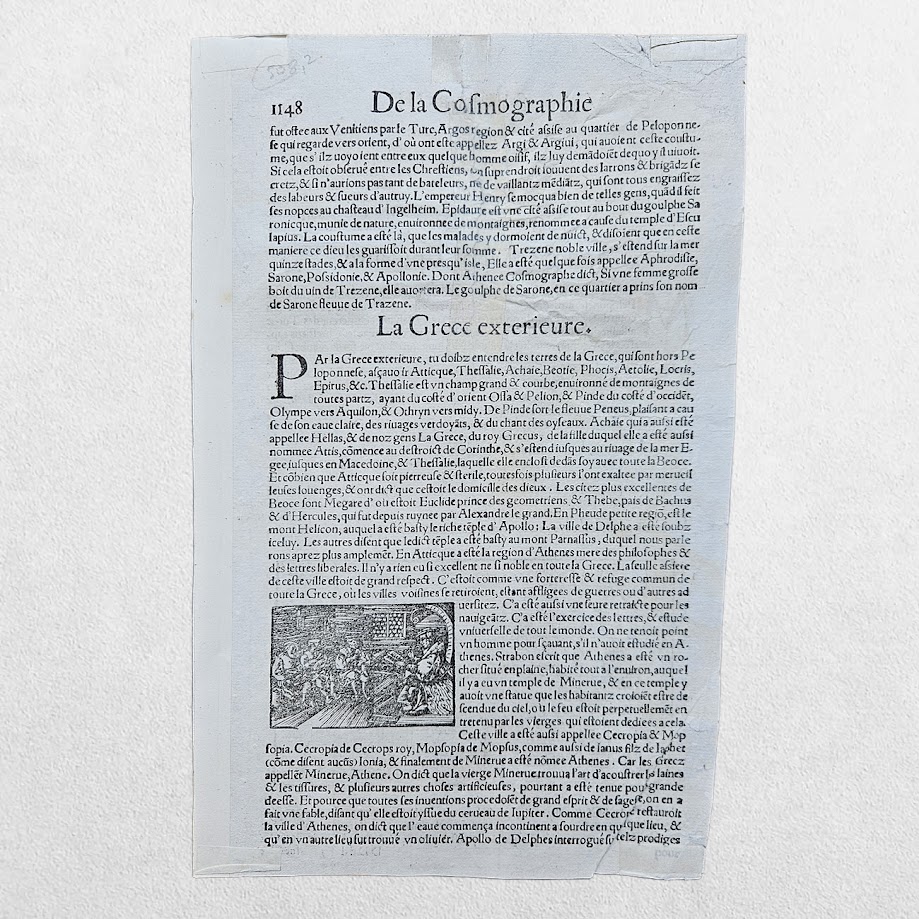
The reverse, p. 1148, continues the geographical discussion before introducing the substantial heading:
“La Grece exterieure.”
This section expands Münster’s account beyond the Peloponnese to the regions of ancient Greece, naming Attica, Thessaly, Achaea, Boeotia, Phocis, Locris and Epirus, among others, and blending sixteenth-century geographical description with classical history and mythology.
A second, smaller woodcut appears within the text. It depicts a seated classical figure within an architectural or garden setting and accompanies Münster’s discussion of Athens and its intellectual traditions. The surrounding text refers to Athens as the mother of philosophers and celebrates the city’s ancient reputation for letters and learning.
Sebastian Münster and the Cosmographia
Sebastian Münster (1488–1552) was one of the most influential cartographers, Hebraists and cosmographers of Renaissance Europe. His Cosmographia, first published at Basel in 1544, became an extraordinary publishing success, appearing in numerous German, Latin, French, Italian and Czech editions during the following decades.
The work was far more than an atlas. Münster attempted a description of the whole known world through a combination of:
- geography and cartography;
- town and city views;
- political and dynastic history;
- classical history;
- warfare;
- customs and costume;
- flora and fauna;
- religion;
- legendary and historical material.
Chetham’s Library describes the Cosmographia as both scientific and popular, incorporating maps and views alongside rulers, customs, occupations, natural history and accounts of the peoples of the world.
The French translation formed an important part of the work’s international dissemination. French editions appeared repeatedly during the sixteenth century, including editions of 1552, 1556, 1560, 1565 and 1568.
Greece and the Classical World
This is an especially appealing Münster leaf because the subject combines Renaissance geography with the classical Greek world.
Names including Modon, Argos, Epidaurus and Athens immediately connect the leaf with both the contemporary Ottoman eastern Mediterranean and the ancient world familiar from Greek history and literature.
The reverse’s discussion of La Grece exterieure explicitly invokes the classical geography of Attica, Achaea, Thessaly and Boeotia and treats Athens as a centre of philosophy and learning. It therefore illustrates very clearly Münster’s characteristic method: sixteenth-century geography is continually explained through the surviving intellectual inheritance of antiquity.
There is even a restrained Homeric/Odyssey association available here because the geography is that of the Peloponnese and Aegean world familiar from ancient Greek epic. It would, however, be misleading to call the woodcut itself an illustration of the Odyssey or to claim that it represents a specific Homeric episode.
Condition
Good condition overall for an original leaf printed in 1568.
There is general age-toning and light scattered spotting, with some marginal browning and surface marking. The upper portion displays an old crease or short closed tear and there are further old fold lines and marginal irregularities. The margins have evidently undergone historic mounting or strengthening, with narrow paper strips visible particularly along the edges and on the reverse.
There are faint old pencil inscriptions and collector’s annotations.
The important printed areas remain substantially complete and clearly legible, and both woodcuts retain strong impressions. The larger Modon view is complete and presents particularly well.
Please study the photographs carefully as they form an important part of the condition description.
Author: Sebastian Münster (1488–1552)
Work: La Cosmographie Universelle
Book: Livre IIII / Book IV
Pages: 1147–1148
Principal Heading: “Modone, Argos, Epidaure.”
Further Section: “La Grece exterieure.”
Place of Publication: Basel
Printer / Publisher: Heinrich Petri
Date: 1568
Language: French.
Size: Approximately 18.2 x 29.1 cm
Technique: Original woodcut illustrations with letterpress text on laid paper.
Subjects
Greece; Peloponnese; Methoni; Modon; Argos; Epidaurus; Athens; Attica; Renaissance geography; classical Greece; Ottoman Greece; Venetian Mediterranean history.
Authentication and Research
This leaf has been handled, inspected and catalogued in-house at our Ripon gallery. Its pagination, headings, language and illustrations have been checked against the institutional record for the 1568 Basel French edition preserved by the Universitätsbibliothek Basel. A separately marketed example bearing the same “Modone, Argos, Epidaure” subject has also been independently identified as a 1568 Münster woodcut.
Why buy from us?
At Hornseys, we are committed to offering items that meet the highest standards of quality and authenticity. Our book collection is meticulously curated to ensure that each edition is a valuable and authentic piece of bibliographical history. Here’s what sets us apart:
- Authenticity and Provenance: Every book is researched, collated, and verified for authenticity.
- Expert Curation: Each book is selected with a keen eye for significance, condition, and rarity, ensuring a collection that is both diverse and distinguished.
- Customer Satisfaction: We strive to provide an exceptional customer experience, from detailed descriptions and provenance to secure and prompt delivery of your purchase.
- Returns Policy: We offer an unconditional guarantee on every item. If you wish to make a return, books may be sent back to us within fourteen days of receipt for any reason. We request advance notification of returns, and books must be returned in the same condition as sent for a full refund.
Explore Our Collection:
Visit Hornseys to explore our fine collection of rare and signed books. Whether you are an avid collector or looking for a special gift, our selection offers something truly unique. Located in the picturesque Yorkshire Dales, our Ripon gallery has been a haven for book lovers, art enthusiasts, and collectors since 1976.