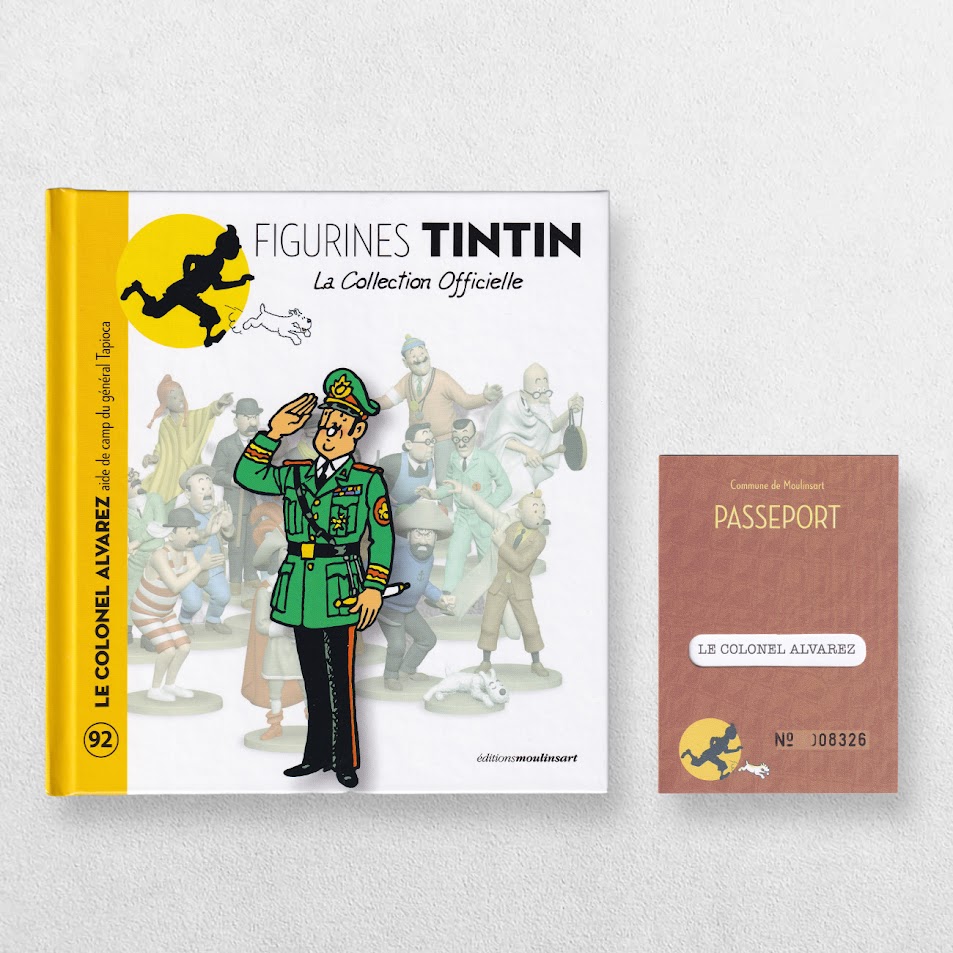
Colonel Alvarez Aide De Camp To General Tapioca – Figurines Tintin La Collection Officielle – 92 – Le Colonel Alvarez Aide De Camp Du Général Tapioca
Author: Hergé & Editions Moulinsart
Price: £90.00
Publisher: Editions Moulinsart
Publication date: 2015
Format: Original pictorial boards with passport and figurine
Condition: In near fine condition
Illustrations: Illustrated throughout
Description:
Original pictorial boards. Includes passport loosely inserted. Text in French. Includes the accompanying figurine. One from the collection of 111 books and figurines. Very slight wear. In very near fine, clean condition overall.
Colonel Alvarez: A Short Biography
Colonel Alvarez appears in The Adventures of Tintin – Tintin and the Picaros (Tintin et les Picaros, first published 1976*), Hergé’s final completed album.
He serves as aide-de-camp to General Tapioca, the dictatorial ruler of the fictional South American republic of San Theodoros.
Though Alvarez occupies only a few frames, his character contributes to Hergé’s portrait of a hollow political regime sustained by ceremony, fear, and opportunism.
Character Overview
| Attribute | Description |
| Full Name | Colonel Alvarez |
| Occupation | Senior officer; aide-de-camp to General Tapioca |
| First Appearance | Tintin and the Picaros (1976) |
| Nationality | San Theodoran |
| Affiliation | Tapioca’s regime |
| Character Type | Minor supporting character; symbol of loyalty to power |
| Role | Embodies the bureaucratic obedience and moral emptiness of dictatorship |
Narrative Role in Tintin and the Picaros
- Political Context
The story opens with General Tapioca ruling San Theodoros, having overthrown his rival General Alcazar, who had once seized power himself in The Broken Ear.
The nation remains locked in a cycle of coups and counter-coups, with Tintin drawn in after his friends, the Thom(p)son twins, are imprisoned on trumped-up charges.
Colonel Alvarez functions as Tapioca’s personal aide, overseeing protocol and relaying orders. His role reflects the structure of a rigid, militarised state in which subordinates act without question.
- Representative of Authoritarian Routine
Alvarez is depicted during official receptions at Tapioca’s palace — standing rigidly beside the General, announcing visitors, or executing ceremonial duties.
He does not display cruelty or passion; instead, he personifies the faceless obedience of career officers who serve whichever power is in command.
In this sense, Alvarez is less a villain than a cog in the machinery of oppression.
- The Transfer of Allegiance
When Alcazar eventually overthrows Tapioca with the help of Tintin and his band of Picaros, Alvarez — like many of the regime’s officers — is quietly absorbed into the new order.
This silent continuity underlines Hergé’s cynicism about political change without moral renewal.
The uniforms and slogans alter, but the same colonels remain in place, saluting a new master.
Characterisation
- Military Precision
Hergé draws Alvarez with immaculate posture, a clipped moustache, and a perfectly pressed uniform.
His every gesture radiates discipline and control.
This meticulous presentation reflects the superficial order of the Tapioca regime: tidy on the surface, corrupt beneath.
- The Loyal Functionary
Unlike Alcazar or Tapioca, Alvarez lacks ambition or ideology.
He embodies the type of the obedient bureaucrat-soldier, defined entirely by hierarchy.
Hergé thus transforms him into an archetype — a man who survives regimes by never questioning them.
- The Quiet Symbol of Stagnation
Where earlier Tintin villains were dynamic or flamboyant, Alvarez is static.
He neither conspires nor revolts.
His inertia becomes symbolic: he represents a class of officers whose loyalty to authority, not to justice, perpetuates dictatorship.
Themes and Symbolism
- Obedience and Moral Vacuum
Through Alvarez, Hergé explores the danger of blind obedience.
In San Theodoros, officers like him maintain stability, but only by suppressing conscience.
His courteous professionalism conceals moral emptiness — a critique not of soldiers themselves, but of systems that reward compliance over conviction.
- The Banality of Power
Alvarez personifies what might be called the banality of dictatorship.
There are no dramatic villains here, only functionaries who salute, sign orders, and keep the machine running.
Hergé’s tone is no longer adventurous but quietly despairing: the real evil is routine, not rebellion.
- Continuity Amid Change
When the revolution comes, Alvarez remains untouched.
His capacity to adapt mirrors the futility of San Theodoros’ endless coups — a satire of modern politics in which regimes change but people do not.
Artistic Depiction
In the clear-line style typical of Hergé’s mature period:
- Uniform: Olive-green military dress with medals and epaulettes, always immaculate.
- Expression: Controlled and impassive, showing deference to his superiors.
- Positioning: Often placed slightly behind Tapioca, reinforcing his subordinate status.
This careful visual hierarchy mirrors the political hierarchy of the story.
Moral and Psychological Reading
- The Mechanism of Authority
Alvarez is not evil but complicit.
His silence and obedience sustain the illusion of order.
Hergé uses him to show how systems of oppression depend not only on tyrants but on the obedient men who execute their will.
- Hergé’s Late-Career Realism
By 1976, Hergé had moved away from clear-cut moral binaries.
The world of Tintin and the Picaros is weary and ambiguous; heroes and villains are no longer easily distinguished.
Alvarez fits perfectly into this greyer moral world — the professional survivor in a landscape of endless coups.
Summary
| Aspect | Description |
| Name | Colonel Alvarez |
| Role | Aide-de-camp to General Tapioca |
| Album | Tintin and the Picaros (1976) |
| Traits | Disciplined, loyal, impassive, bureaucratic |
| Symbolism | Obedient servant of power; moral stagnation |
| Function | Illustrates the continuity and futility of dictatorship |
| Fate | Survives regime change; emblem of unchanging hierarchy |
Conclusion
Colonel Alvarez may seem a minor player, but he encapsulates Hergé’s late vision of politics — a world where revolutions are choreographed, uniforms change colour, and authority persists through the quiet efficiency of men like him.
He is not a monster, merely a man who obeys — and therein lies Hergé’s warning.
Through Alvarez, Tintin and the Picaros reveals that the true endurance of tyranny lies not in generals or ideologies, but in the obedient silence of their aides-de-camp.
Why Buy from Us?
At Hornseys, we are committed to offering items that meet the highest standards of quality and authenticity. Our collection of objects and rare books are carefully curated to ensure each edition is a valuable piece of bibliographical history. Here’s what sets us apart:
- Authenticity and Provenance: Each item is meticulously researched and verified for authenticity and collation.
- Expert Curation: Our selection process focuses on significance, condition, and rarity, resulting in a collection that is both diverse and distinguished.
- Customer Satisfaction: We aim to provide an exceptional customer experience, from detailed descriptions to secure and prompt delivery of your purchase.
- Returns Policy: We offer an unconditional guarantee on every item. If you wish to return an item, it may be sent back to us within fourteen days of receipt. Please notify us in advance if you wish to do so. The item must be returned in the same condition as it was sent for a full refund.
Cataloguer: Daniel Hornsey
Daniel Hornsey has specialised in fine and rare books, ephemera, and collectors’ editions for over thirty years. As a long-standing member of the antiquarian book trade, he has advised private collectors, curated catalogues, and sourced works for leading dealers, libraries and institutions across the world.
Hornseys’ exhibit regularly at book and map fairs in London and throughout the UK and are members of the Provincial Booksellers Fairs Association, the PBFA.
His fascination with Hergé’s work — especially ‘The Adventures of Tintin’ — began in childhood. Daniel recalls reading Tintin in original European editions and quickly recognising that these were not merely children’s books, but finely illustrated narratives crafted with artistic depth and wit.
As noted by the Musée Hergé in Louvain-la-Neuve, Hergé’s ‘ligne claire’ style has influenced generations of European comic artists and his original drawings and paintings command very high prices with his painting of ‘The Blue Lotus’ jar fetching £2.8m at auction in 2021.
By presenting these works through Hornseys’, he hopes to contribute to the continued appreciation of one of the 20th century’s most influential illustrators, helping new generations discover the artistry and legacy of Hergé.