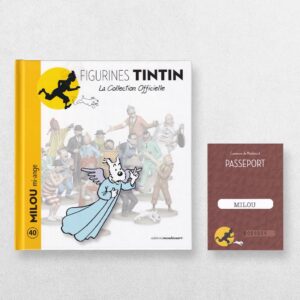
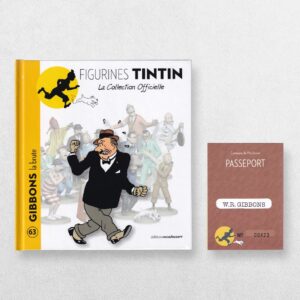
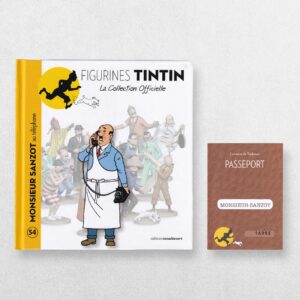
Muganga The Witch Doctor Of The Babaoro’m – Figurines Tintin La Collection Officielle – 100 – Muganga Le Sorcier Des Babaoro’m
Author: Hergé & Editions Moulinsart
Price: £100.00
Publisher: Editions Moulinsart
Publication date: 2015
Format: Original pictorial boards with passport and figurine
Condition: In near fine condition
Illustrations: Illustrated throughout
Description:
Original pictorial boards. Includes passport loosely inserted. Text in French. Includes the accompanying figurine. One from the collection of 111 books and figurines. Very slight wear. In very near fine, clean condition overall.
Muganga: A Short Biography
Muganga, the witch doctor of the Babaoro’m tribe, is one of the central antagonists in Hergé’s early work Tintin in the Congo (Tintin au Congo).
He occupies a key symbolic and narrative position as both the local authority figure and the representative of superstition and resistance within the colonial setting of the story.
Although Muganga is portrayed through the racial and cultural stereotypes typical of European colonial ideology in the 1930s, his role within the story provides a revealing insight into the ideological framework and artistic development of Hergé’s early career.
Character Overview
| Attribute |
Description |
| Name |
Muganga |
| Title in French |
Le sorcier des Babaoro’m |
| English Translation |
“The witch doctor of the Babaoro’m” |
| Tribal Affiliation |
The Babaoro’m, a fictional Congolese tribe |
| First Appearance |
Tintin in the Congo (Tintin au Congo, 1931) |
| Role in Story |
Antagonist; witch doctor and traditional leader |
| Personality Traits |
Proud, manipulative, superstitious, power-hungry |
| Symbolism |
Represents superstition, fear, and resistance to foreign influence |
- Narrative Role in Tintin in the Congo
Muganga first appears as the tribal witch doctor who exercises spiritual and social authority over the Babaoro’m people. His status depends upon fear, ritual, and superstition. When Tintin arrives in the region, Muganga immediately perceives him as a threat to his authority.
To preserve his power, Muganga plots against Tintin, accusing him of witchcraft and attempting to have him killed. His schemes include manipulating tribal beliefs and enlisting the help of a Western villain (the American gangster Tom) to discredit Tintin.
Ultimately, Muganga’s deceit is exposed, and Tintin wins the loyalty of the tribe. In line with the moral conventions of early adventure literature, Tintin’s triumph symbolises the victory of reason and modernity over superstition and ignorance — a narrative that reflects the Eurocentric attitudes of its time.
- Characterisation
Muganga is portrayed as both cunning and cowardly, combining a desire for power with a reliance on fear and manipulation. His control of the tribe rests on spiritual intimidation rather than moral integrity.
Hergé’s early storytelling simplifies Muganga into a caricature of the “false priest”, a trope common in colonial-era adventure fiction, in which native religious figures oppose the European protagonist’s “civilising mission.”
Although drawn as a villain, Muganga is not motivated by inherent evil; rather, he represents self-preservation in a collapsing power structure — the local leader struggling to maintain control as foreign forces upend his world.
- Artistic Depiction
Muganga’s design follows the visual conventions of Hergé’s early “ligne claire” style:
- Costume: Traditional tribal garb, headdress, and ritual accessories.
- Expression: Exaggerated facial features reflecting anxiety and fury.
- Body Language: Dramatic, gestural, often shown in ritualistic movement.
These visual cues reflect Hergé’s limited understanding of African cultures at the time, based largely on missionary journals, colonial imagery, and European newspapers. The result is a stylised and racially stereotyped figure, typical of early 20th-century European art rather than authentic ethnography.
- Thematic Analysis
| Theme |
Interpretation |
| Superstition vs. Rationality |
Muganga’s downfall marks the triumph of Western “reason” over local belief systems — a colonial trope. |
| Power and Authority |
His jealousy of Tintin reflects the fragility of traditional power when confronted with foreign influence. |
| Cultural Misunderstanding |
The portrayal of Muganga mirrors 1930s European ignorance about African societies. |
| Moral Allegory |
The story presents Muganga as morally inferior, contrasting his deceit with Tintin’s honesty and curiosity. |
While this structure served as an adventure framework for young readers, it also reveals Hergé’s early moral simplifications, which he later came to regret and revise in tone and depth in later works such as The Blue Lotus and Tintin in Tibet.
- Historical and Cultural Context
When Tintin in the Congo was first serialised in Le Petit Vingtième in 1930–31, Belgium still governed the Belgian Congo as a colonial possession.
The story reflects — and at times unconsciously endorses — the paternalistic view that European intervention was a force for enlightenment.
Muganga’s opposition to Tintin embodies this colonial binary: the “civilised European” bringing science and order versus the “primitive native” clinging to superstition.
In later decades, both Hergé and readers recognised these portrayals as racially insensitive. Hergé himself acknowledged that the story was a product of its time and of his own limited worldview as a young artist in a colonial society.
- Muganga’s Symbolic Function
Beyond his individual personality, Muganga represents the symbolic antagonist of progress — a figure caught between tradition and transformation.
His conflict with Tintin is less personal than allegorical: a clash between old belief systems and new forms of authority.
Yet, with hindsight, this binary reflects not a moral truth but the ideological assumptions of 1930s Europe. Muganga’s “defeat” can be read as a metaphor for colonial domination, where European rationality was imposed as the universal standard.
- Evolution of Hergé’s Worldview
Muganga’s portrayal, though simplistic, marks an early stage in Hergé’s artistic and moral development.
As Hergé matured, he moved beyond colonial stereotypes toward greater cultural respect and psychological depth.
In later works such as The Blue Lotus (1936), Hergé directly challenged Western arrogance and portrayed non-European characters — notably Chang Chong-Chen — as equals and moral guides. The contrast between Muganga and Chang therefore illustrates Hergé’s own evolution from prejudice to empathy.
Summary
| Aspect |
Description |
| Name |
Muganga |
| Title |
The witch doctor of the Babaoro’m |
| Appearance |
Tintin in the Congo (1931) |
| Role |
Local antagonist; tribal spiritual leader |
| Traits |
Cunning, jealous, manipulative, insecure |
| Symbolism |
Superstition resisting modernity; colonial fear of the “other” |
| Narrative Function |
To contrast Tintin’s reason with perceived native superstition |
| Modern Perspective |
A problematic but instructive example of colonial-era storytelling |
Conclusion
Muganga, the witch doctor of the Babaoro’m, is a figure both shaped by and trapped within the colonial imagination of early 20th-century Europe.
In Tintin in the Congo, he is cast as the villain, the obstacle to Tintin’s “civilising mission.” Yet, when viewed through a contemporary lens, he stands as a symbol of cultural misunderstanding and historical context — a character whose flaws lie not only in his actions but in the worldview that created him.
Though his portrayal reflects the prejudices of the time, Muganga’s presence offers a crucial insight into Hergé’s artistic journey: from youthful imitation of colonial adventure stories to mature reflection on human equality, empathy, and truth.
Why Buy from Us?
At Hornseys, we are committed to offering items that meet the highest standards of quality and authenticity. Our collection of objects and rare books are carefully curated to ensure each edition is a valuable piece of bibliographical history. Here’s what sets us apart:
- Authenticity and Provenance: Each item is meticulously researched and verified for authenticity and collation.
- Expert Curation: Our selection process focuses on significance, condition, and rarity, resulting in a collection that is both diverse and distinguished.
- Customer Satisfaction: We aim to provide an exceptional customer experience, from detailed descriptions to secure and prompt delivery of your purchase.
- Returns Policy: We offer an unconditional guarantee on every item. If you wish to return an item, it may be sent back to us within fourteen days of receipt. Please notify us in advance if you wish to do so. The item must be returned in the same condition as it was sent for a full refund.
Cataloguer: Daniel Hornsey
Daniel Hornsey has specialised in fine and rare books, ephemera, and collectors’ editions for over thirty years. As a long-standing member of the antiquarian book trade, he has advised private collectors, curated catalogues, and sourced works for leading dealers, libraries and institutions across the world.
Hornseys’ exhibit regularly at book and map fairs in London and throughout the UK and are members of the Provincial Booksellers Fairs Association, the PBFA.
His fascination with Hergé’s work — especially ‘The Adventures of Tintin’ — began in childhood. Daniel recalls reading Tintin in original European editions and quickly recognising that these were not merely children’s books, but finely illustrated narratives crafted with artistic depth and wit.
As noted by the Musée Hergé in Louvain-la-Neuve, Hergé’s ‘ligne claire’ style has influenced generations of European comic artists and his original drawings and paintings command very high prices with his painting of ‘The Blue Lotus’ jar fetching £2.8m at auction in 2021.
By presenting these works through Hornseys’, he hopes to contribute to the continued appreciation of one of the 20th century’s most influential illustrators, helping new generations discover the artistry and legacy of Hergé.