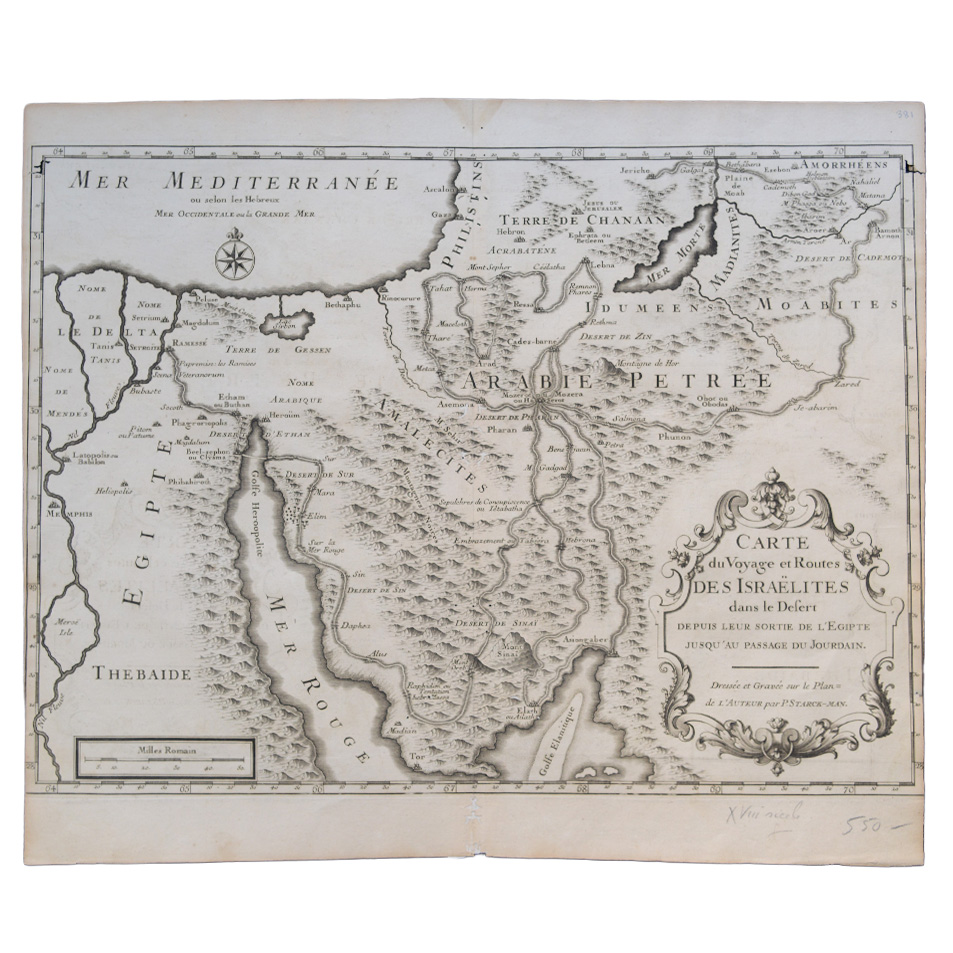
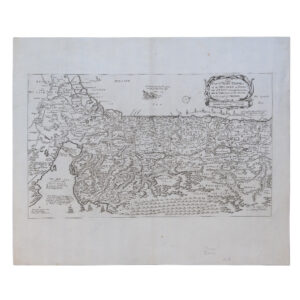
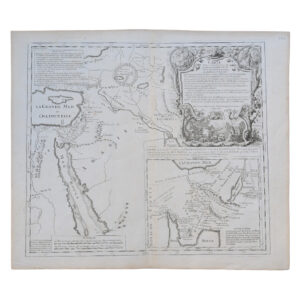
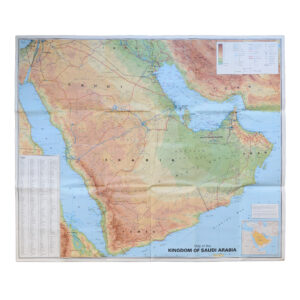
Arabia – The Mediterranean Sea – Egypt – The Holy Land – Jordan – The Arabian Peninsula – Carte du Voyage Et Routes Des Israelites Dans Le Desert – 1720
Cartographer: Starckman, P
Place: Paris, France
Price: £95 including postage in the UK
Publication Date: 1720
Edition: Not stated
Sheet Size: 45.4cm x 38.6cm
Condition: Good
Condition:
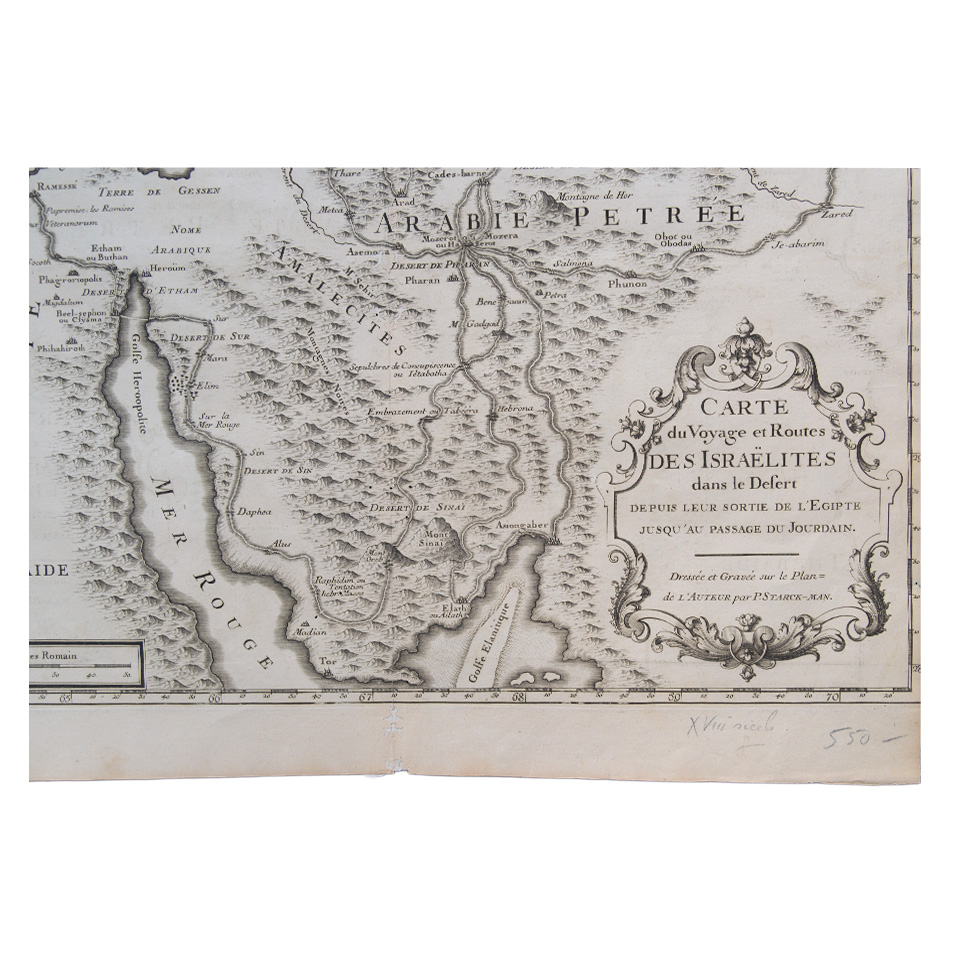
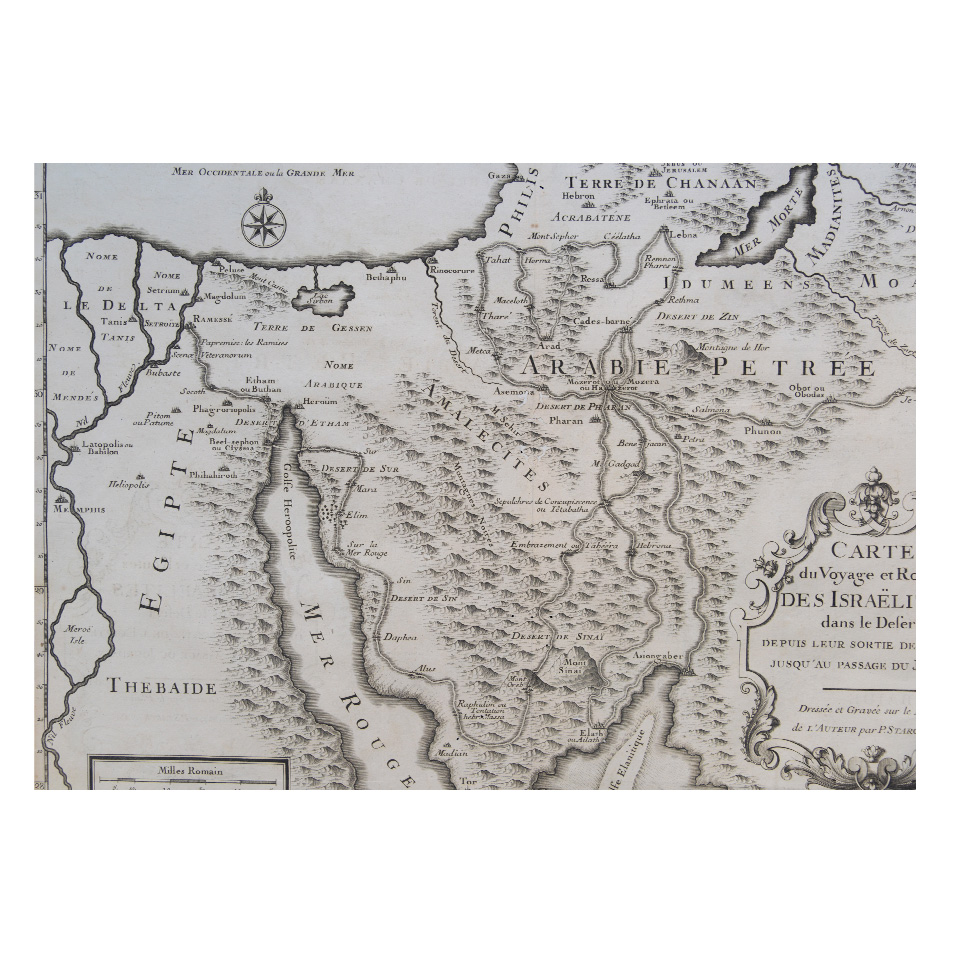
Original copper engraved map. Date: 1720. Sheet size: 45.4cm x 38.6cm. Uncoloured. An uncommon map of the Holy Land. Also shows the Arabian Peninsula, Jordan, Syria and eastern Egypt. Shows the Exodus from Egypt beginning in Ramessé (Ramses), crossing the Red Sea, then wandering the Arabian Peninsula, including a visit to Mount Sinai. Some worming of the centrefold which has been repaired to the reverse with old paper. Includes other worming in the line border at the top sides, light age-toning and trimmed close at the sides with minor loss of printed line border. In good condition overall. Scarce.
The Arabian Peninsula In The Time Of The Israelites: A Brief Overview
The period conventionally referred to as “the time of the Israelites” spans roughly from the Late Bronze Age to the early Iron Age (c. 1500–600 BC), encompassing the Exodus traditions, the wilderness wanderings, the settlement of Canaan, and the monarchic period of Israel and Judah. During this era, the Arabian Peninsula was not a marginal or empty land but a complex region of tribal societies, trade routes, kingdoms, and sacred landscapes, closely connected to the Levant through commerce, migration, and cultural exchange.
- Geography and Environmental Conditions
Regional Diversity
The Arabian Peninsula was (and remains) geographically varied:
- Northern Arabia: semi-arid steppe and desert zones, closely linked to the Levant
- Western Arabia (Hijaz): mountainous regions and caravan corridors along the Red Sea
- Southern Arabia (Yemen): fertile highlands supported by seasonal monsoon rains
- Eastern Arabia: coastal plains along the Persian Gulf
These environmental differences shaped patterns of settlement, mobility, and political organisation.
Climate
The Late Bronze and early Iron Age climate was broadly similar to today’s, though slightly wetter in some regions. Survival depended on:
- Control of wells and oases
- Seasonal migration
- Pastoral nomadism combined with limited agriculture
- Peoples of the Arabian Peninsula
Nomadic and Semi-Nomadic Tribes
Much of Arabia was inhabited by tribal pastoralists, moving with herds of sheep, goats, and camels. These groups:
- Lived in kin-based societies
- Valued hospitality, honour, and lineage
- Controlled routes rather than territory
Biblical texts refer to groups such as:
- Midianites
- Ishmaelites
- Amalekites
- Kedarites
These were not unified nations but loose confederations.
Sedentary Communities
In oasis towns and fertile regions, sedentary populations practised:
- Date cultivation
- Limited cereal farming
- Craft production
Such settlements acted as trade hubs and meeting points between nomads and merchants.
- Trade Routes and Economic Life
Caravan Trade
By the second millennium BC, Arabia was integrated into long-distance trade networks linking:
- Egypt
- The Levant
- Mesopotamia
- Southern Arabia
Key goods included:
- Frankincense and myrrh (from southern Arabia)
- Aromatics and spices
- Metals and semi-precious stones
Northern Arabia and the Hijaz functioned as corridors, not endpoints, in these networks.
Israelite Interaction
Biblical narratives reflect this reality:
- Joseph is sold to traders travelling toward Egypt
- Midianite traders appear frequently
- The Israelites encounter Arabian groups during wilderness traditions
These accounts align with known trade patterns.
- Northern Arabia and the Biblical World
Midian
Midian is especially significant:
- Located in north-western Arabia, east of the Gulf of Aqaba
- Associated with Moses’ exile and marriage
- Home to a priestly figure (Jethro) who recognises Israel’s God
Midian appears as a culturally close but distinct society, not hostile by default.
Edom and Transjordan
While Edom lay east of the Arabah (modern southern Jordan), it formed a bridge zone between Canaan and Arabia. Relations between Israel and Edom were:
- Kin-based in tradition
- Politically tense in practice
Edom controlled key trade routes linking Arabia to the Levant.
- Religious Landscape
Polytheism and Local Deities
Most Arabian societies practised localised polytheism, centred on:
- Tribal gods
- Astral deities (sun, moon, stars)
- Sacred stones, groves, and wells
Religion was practical and communal rather than doctrinal.
Shared Religious Concepts
Despite theological differences, there were overlaps with Israelite religion:
- Sacrifice
- Covenant-like oaths
- Sacred mountains and wilderness spaces
The wilderness itself was often viewed as a place of divine encounter, not absence.
- The Wilderness Traditions and Arabia
The Sinai Question
The biblical wilderness wanderings are traditionally associated with Sinai, whose precise location is debated. Proposals include:
- The Sinai Peninsula
- North-western Arabia
Regardless of geography, the narratives reflect:
- Desert pastoral realities
- Interaction with Arabian tribal societies
- Knowledge of desert survival
The setting is culturally consistent with northern Arabian environments.
Life in the Wilderness
Nomadic life involved:
- Tent-dwelling
- Seasonal movement
- Reliance on flocks
- Strong clan leadership
These features are reflected accurately in biblical descriptions.
- Southern Arabia: Distant but Influential
Early Kingdoms
In southern Arabia, early complex societies were emerging:
- Proto-Sabaean and Minaean cultures
- Advanced irrigation systems
- Monumental architecture
These regions were not directly involved in Israelite history at this stage but influenced the wider Near Eastern economy through incense trade.
Later biblical traditions (e.g. the Queen of Sheba) reflect awareness of this southern wealth.
- Political Organisation
Tribal Authority
Most Arabian societies lacked centralised states:
- Authority rested with chiefs and elders
- Leadership was personal and negotiable
- Warfare was limited in scale
This contrasts with the emerging monarchies of Israel and Judah but allowed flexible alliances.
Interaction with Empires
Arabian groups were increasingly drawn into the orbit of:
- Egyptian influence
- Assyrian expansion (later in the Iron Age)
Assyrian records begin to mention Arabian tribes as political and military actors.
- Arabia and Israelite Identity
The Arabian Peninsula played a formative role in Israelite self-understanding:
- Ancestors are portrayed as semi-nomadic pastoralists
- Wilderness experience becomes central to theology
- Arabia functions as a space of testing, formation, and encounter
Rather than a peripheral backdrop, Arabia is a cultural neighbour and mirror to early Israel.
Conclusion
In the time of the Israelites, the Arabian Peninsula was a dynamic, inhabited, and interconnected region, not an empty desert. Its tribes, trade routes, and religious traditions formed an essential part of the world in which Israel emerged. Northern Arabia, in particular, shared cultural patterns with early Israel, while southern Arabia exerted economic influence across the Near East.
The biblical portrayal of Arabia—especially in wilderness narratives—aligns closely with what is known of Late Bronze and early Iron Age Arabian life. Arabia was not simply a place Israel passed through, but a region that shaped its economy, theology, and identity in lasting ways.
Why buy from us?
At Hornseys, we are committed to offering items that meet the highest standards of quality and authenticity. Our collection is meticulously curated to ensure that each item is a valuable and authentic piece of history. Here’s what sets us apart:
- Authenticity and Provenance: Every item is researched, collated, and verified for authenticity.
- Expert Curation: Each item is selected with a keen eye for significance, condition, and rarity, ensuring a collection that is both diverse and distinguished.
- Customer Satisfaction: We strive to provide an exceptional customer experience, from detailed descriptions and provenance to secure and prompt delivery of your purchase.
- Returns Policy: We offer an unconditional guarantee on every item. If you wish to make a return, items may be sent back to us within fourteen days of receipt for any reason. We request advance notification of returns, and items must be returned in the same condition as sent for a full refund.
Explore Our Collection:
Visit Hornseys to explore our fine collection of rare and signed books, maps, artwork and objects. Whether you are an avid collector or looking for a special gift, our selection offers something truly unique. Located in the picturesque Yorkshire Dales, our Ripon gallery has been a haven for book lovers, art enthusiasts, and collectors since 1976.
Thank you for looking.