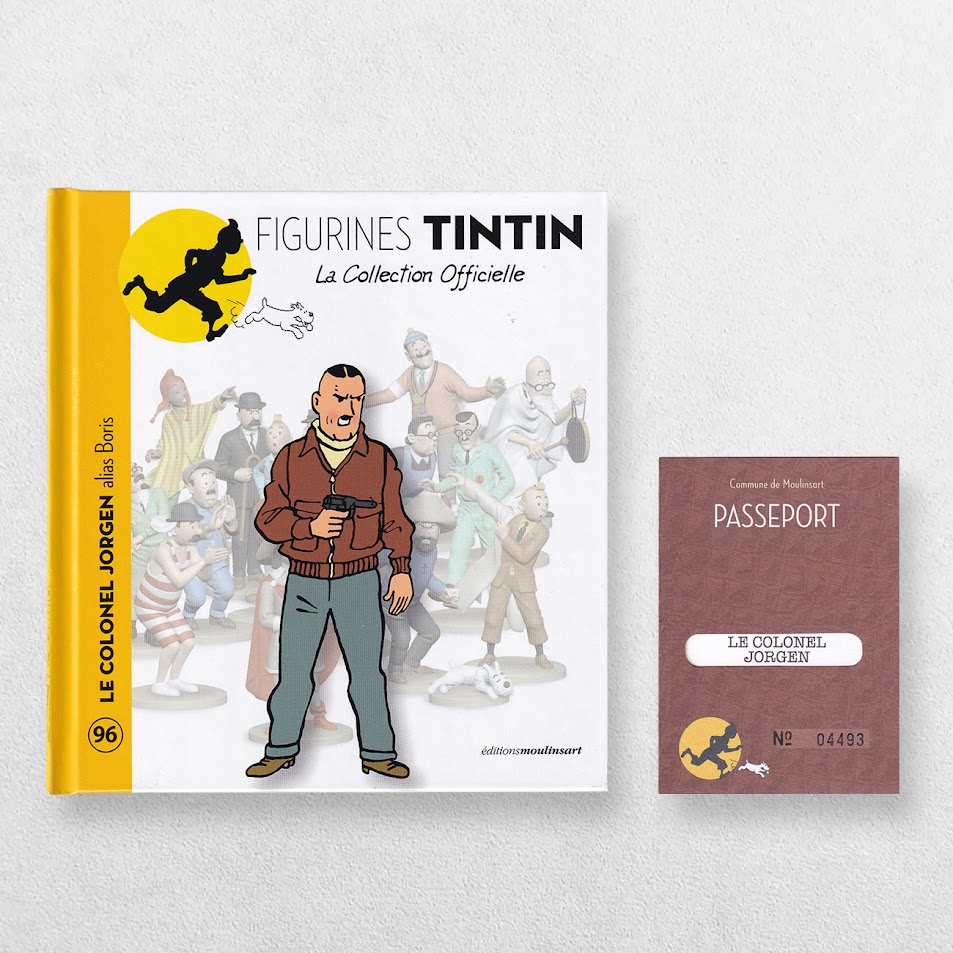
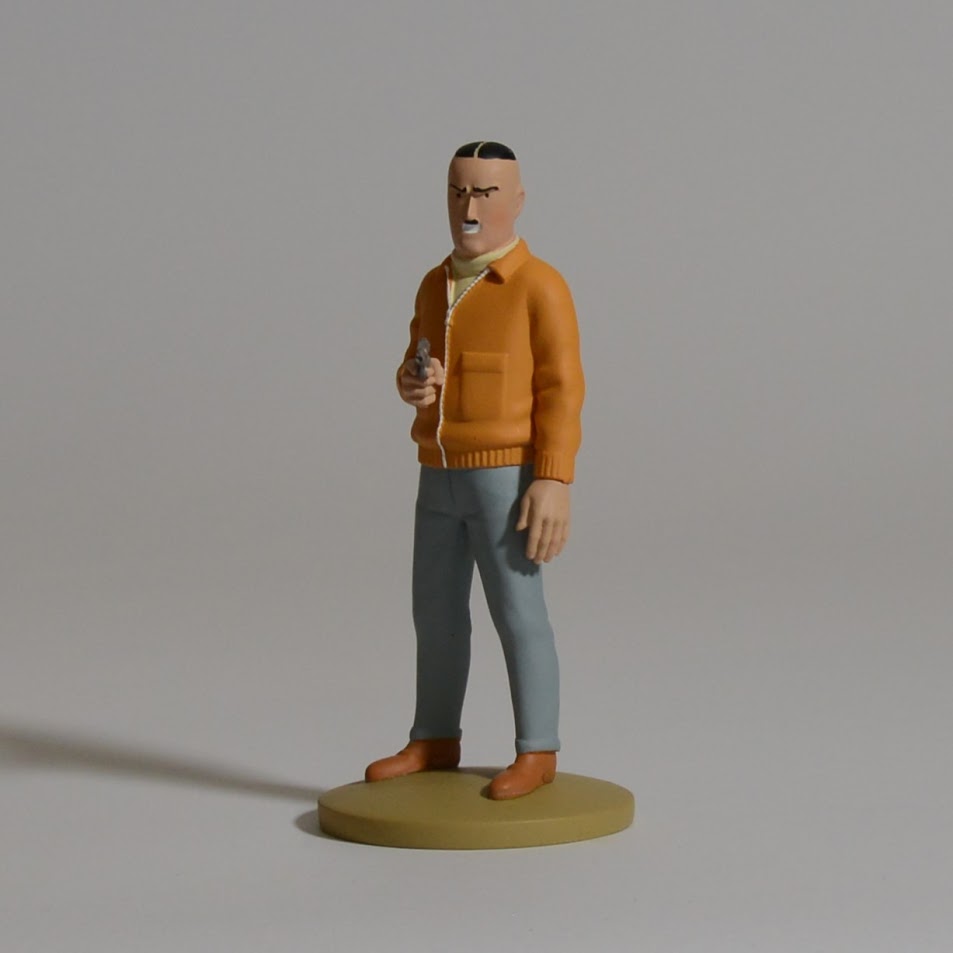
Colonel Jorgen Alias Boris – Figurines Tintin La Collection Officielle – 96 – Le Colonel Jorgen Alias Boris
Author: Hergé & Editions Moulinsart
Price: £100.00
Publisher: Editions Moulinsart
Publication date: 2015
Format: Original pictorial boards with passport and figurine
Condition: In near fine condition
Illustrations: Illustrated throughout
Description:
Original pictorial boards. Includes passport loosely inserted. Text in French. Includes the accompanying figurine. One from the collection of 111 books and figurines. Very slight wear. In very near fine, clean condition overall.
Colonel Jorgen: A Short Biography
Colonel Jorgen, also known by his earlier alias Boris, is a recurring villain in The Adventures of Tintin, appearing first as Boris in The Secret of the Unicorn (Le Secret de la Licorne, 1943*) and later, in a far more chilling incarnation, as Colonel Jorgen, the secret police chief in The Calculus Affair (L’Affaire Tournesol, 1956*).
His evolution from a petty criminal to a powerful intelligence officer is one of Hergé’s most sophisticated acts of character continuity. It reflects both the author’s deepening realism and his engagement with the moral atmosphere of post-war Europe, particularly the anxiety surrounding totalitarianism and state surveillance.
Character Overview
| Attribute |
Description |
| Full Name |
Colonel Jorgen (formerly known as Boris) |
| Nationality |
Bordurian (fictional Eastern European dictatorship) |
| Occupation |
Military officer and secret police operative |
| First Appearance |
The Secret of the Unicorn (as Boris, 1943) |
| Major Appearance |
The Calculus Affair (as Colonel Jorgen, 1956) |
| Affiliation |
Government of Marshal Kûrvi-Tasch, dictator of Borduria |
| Personality Traits |
Ruthless, precise, manipulative, ideologically rigid |
| Symbolism |
The persistence of authoritarian evil beneath changing political systems |
- Early Appearance – Boris in The Secret of the Unicorn
In The Secret of the Unicorn, Boris appears as an underling within a network of criminals seeking the treasure of Sir Francis Haddock.
Although his role is minor, his demeanour is already defined by cunning, discipline, and quiet menace.
He operates in the shadows, handling logistics and intelligence rather than direct violence — traits that foreshadow his later transformation into a military bureaucrat.
At this stage, Boris is a typical wartime villain — a spy and smuggler motivated by greed and secrecy.
However, Hergé’s decision to later reuse the character name “Boris” as “Jorgen” implies a deeper continuity: that the instincts of the spy easily become the tools of political control.
- The Calculus Affair – Colonel Jorgen Emerges
In The Calculus Affair, Boris reappears under a new identity: Colonel Jorgen, aide and intelligence officer in the service of Marshal Kûrvi-Tasch, the moustachioed dictator of the totalitarian state of Borduria.
Here, he is no longer a petty conspirator but a symbol of the Cold War security apparatus — efficient, polite, and terrifyingly impersonal.
He oversees the kidnapping of Professor Calculus, whose invention of a sonic weapon has drawn interest from rival powers.
Jorgen manages interrogations, coordinates surveillance, and directs Tintin’s arrest, serving as the human face of the Bordurian regime’s bureaucratic cruelty.
- Psychological and Political Reading
The Bureaucrat of Oppression
Colonel Jorgen represents a type of evil that is methodical rather than emotional.
He is intelligent, cultured, and outwardly civil — yet entirely devoid of empathy.
Hergé portrays him as the kind of official who commits atrocities not out of hatred, but out of obedience and efficiency.
This subtle portrait anticipates modern understandings of totalitarian psychology: the notion that tyranny depends not only on leaders but on administrators who rationalise injustice as duty.
The Transformation of Boris
The shift from “Boris” to “Colonel Jorgen” encapsulates the evolution of political corruption.
Where once he was a criminal in the private sphere, he now embodies institutionalised corruption — legitimised by uniform and ideology.
Through this metamorphosis, Hergé comments on the disturbing ease with which personal vice becomes political power.
- Symbolism and Themes
| Theme |
Interpretation |
| Totalitarian Control |
Jorgen’s role in Borduria reflects the pervasive reach of the state and the suppression of individual freedom. |
| The Banality of Evil |
Like bureaucrats in real-world regimes, he commits cruelty through orderliness, not rage. |
| Identity and Reinvention |
His two identities — Boris and Jorgen — illustrate how evil adapts, hiding behind legitimacy. |
| Fear and Surveillance |
His omnipresence within Borduria mirrors Cold War anxieties about spying, control, and political imprisonment. |
- Visual Depiction
Hergé renders Jorgen with striking restraint:
- Appearance: Tall, impeccably uniformed, clean-cut, with coldly efficient eyes.
- Posture: Military precision — upright, measured, unemotional.
- Expression: Controlled to the point of menace; rarely angry, always composed.
The uniform itself is significant. His Bordurian insignia and military decorum lend him authority and credibility, concealing the moral decay beneath the polished surface.
- Relationship with Tintin
Unlike earlier villains such as Rastapopoulos or Allan, Jorgen poses a more intellectual threat.
He is not physically violent but strategically manipulative, relying on political power rather than brute force.
Tintin’s moral courage contrasts sharply with Jorgen’s moral servitude.
While Tintin acts according to conscience, Jorgen obeys ideology — a dichotomy that encapsulates The Calculus Affair’s central moral question: whether obedience to authority can ever justify wrongdoing.
- Hergé’s Moral and Historical Context
When The Calculus Affair was published in 1956, Europe was gripped by Cold War tension.
Borduria — with its slogans, uniforms, and moustachioed leader — evokes a hybrid of Nazi Germany and Stalinist Eastern Europe.
Through Colonel Jorgen, Hergé channels the moral unease of the era: the fear that Europe’s dictatorships had not vanished, but merely changed language and form.
Hergé’s treatment of Jorgen is therefore not caricature but commentary — a reflection on how totalitarian systems thrive through people who seem normal, even respectable.
- Legacy and Interpretation
Colonel Jorgen remains one of Hergé’s most understated yet enduring villains.
He lacks the flamboyance of Rastapopoulos or the comic greed of Allan, but he embodies something far more chilling: the everyday face of organised evil.
His dual identity as Boris and Jorgen bridges the two halves of Tintin’s world — the pulpy adventure of the 1940s and the mature political realism of the 1950s.
He reminds readers that history, like villainy, is cyclical: yesterday’s smuggler becomes tomorrow’s minister.
Summary
| Aspect |
Description |
| Name(s) |
Colonel Jorgen (alias Boris) |
| Appears In |
The Secret of the Unicorn (1943); The Calculus Affair (1956) |
| Role |
Antagonist; secret police chief and political operative |
| Personality |
Cold, intelligent, methodical, obedient |
| Symbolism |
The banality and adaptability of evil in modern politics |
| Artistic Style |
Clear-line realism; understated menace |
| Legacy |
A pivotal link between early Tintin adventure and Hergé’s later moral realism |
Conclusion
Colonel Jorgen, also known as Boris, stands as one of Hergé’s most quietly powerful creations — a villain without theatrics, defined instead by control, calculation, and a chilling normality.
He embodies the bureaucratic evil of the modern age: the official who serves tyranny not from passion but from duty, whose uniform sanitises cruelty.
In Tintin’s moral universe — where courage, compassion, and truth prevail — Jorgen’s presence reminds us that the gravest dangers often wear the calm, respectable mask of authority.
He is not a monster, but a mirror — reflecting the unsettling truth that evil, when organised and rationalised, becomes almost ordinary.
Why Buy from Us?
At Hornseys, we are committed to offering items that meet the highest standards of quality and authenticity. Our collection of objects and rare books are carefully curated to ensure each edition is a valuable piece of bibliographical history. Here’s what sets us apart:
- Authenticity and Provenance: Each item is meticulously researched and verified for authenticity and collation.
- Expert Curation: Our selection process focuses on significance, condition, and rarity, resulting in a collection that is both diverse and distinguished.
- Customer Satisfaction: We aim to provide an exceptional customer experience, from detailed descriptions to secure and prompt delivery of your purchase.
- Returns Policy: We offer an unconditional guarantee on every item. If you wish to return an item, it may be sent back to us within fourteen days of receipt. Please notify us in advance if you wish to do so. The item must be returned in the same condition as it was sent for a full refund.
Cataloguer: Daniel Hornsey
Daniel Hornsey has specialised in fine and rare books, ephemera, and collectors’ editions for over thirty years. As a long-standing member of the antiquarian book trade, he has advised private collectors, curated catalogues, and sourced works for leading dealers, libraries and institutions across the world.
Hornseys’ exhibit regularly at book and map fairs in London and throughout the UK and are members of the Provincial Booksellers Fairs Association, the PBFA.
His fascination with Hergé’s work — especially ‘The Adventures of Tintin’ — began in childhood. Daniel recalls reading Tintin in original European editions and quickly recognising that these were not merely children’s books, but finely illustrated narratives crafted with artistic depth and wit.
As noted by the Musée Hergé in Louvain-la-Neuve, Hergé’s ‘ligne claire’ style has influenced generations of European comic artists and his original drawings and paintings command very high prices with his painting of ‘The Blue Lotus’ jar fetching £2.8m at auction in 2021.
By presenting these works through Hornseys’, he hopes to contribute to the continued appreciation of one of the 20th century’s most influential illustrators, helping new generations discover the artistry and legacy of Hergé.