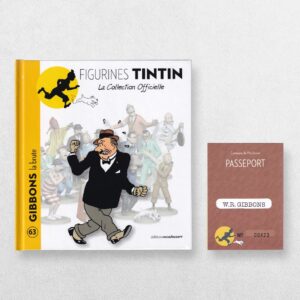
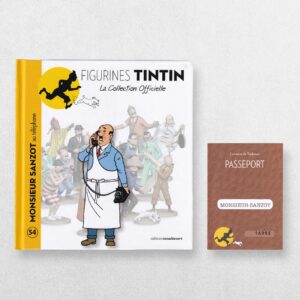
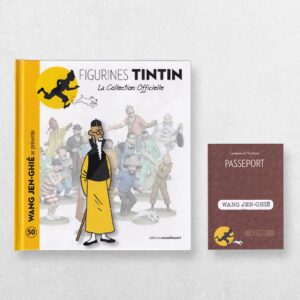
Wronzoff The Accomplice Of Doctor Müller – Figurines Tintin La Collection Officielle – 103 – Le Complice Du Docteur Müller

Hergé & Editions Moulinsart

£70.00

Availability: In stock

Product Description

Wronzoff The Accomplice Of Doctor Müller – Figurines Tintin La Collection Officielle – 103 – Le Complice Du Docteur Müller

Author: Hergé & Editions Moulinsart
Price: £70.00
Publisher: Editions Moulinsart
Publication date: 2015
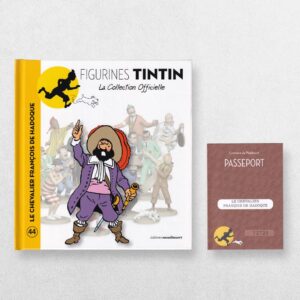
Format: Original pictorial boards with passport and figurine
Condition: In near fine condition
Illustrations: Illustrated throughout

Description:

Original pictorial boards. Includes passport loosely inserted. Text in French. Includes the accompanying figurine. One from the collection of 111 books and figurines. Very slight wear. In very near fine, clean condition overall.

Wronzoff: A Short Biography

Wronzoff is a supporting antagonist in The Black Island (L’Île Noire), one of Hergé’s most atmospheric adventure stories. He appears as the accomplice and henchman of Doctor Müller, the criminal mastermind behind a European counterfeiting ring. Although Wronzoff is a secondary figure, his presence contributes to Hergé’s creation of a dark, pre-war world of espionage, deceit, and cross-border criminality. Through him, Hergé develops a recurring motif: the loyal yet morally compromised subordinate who enables greater evil.

Character Overview

AttributeDescription
NameWronzoff
Title in FrenchLe complice du docteur Müller
English Translation“The accomplice of Doctor Müller”
First AppearanceThe Black Island (L’Île Noire, 1938; revised edition 1966)
NationalityUnspecified (suggested Eastern or Central European)
OccupationCriminal associate; enforcer and operative for Müller
Personality TraitsLoyal, menacing, obedient, practical rather than ideological
SymbolismThe shadow of authority; the willing instrument of corruption

Context:

The World of The Black Island

The Black Island occupies a special place in The Adventures of Tintin. Originally published in 1938 and later redrawn twice, it blends classic detective fiction with a vivid sense of European intrigue.

The story begins with Tintin discovering a network of counterfeiters operating from a remote castle off the Scottish coast. The ringleader is Doctor Müller, a recurring villain also seen in The Land of Black Gold (Tintin au pays de l’or noir). Wronzoff serves as his trusted associate, assisting in logistics, intimidation, and concealment.

Hergé’s depiction of the Müller–Wronzoff duo reflects the political tensions of 1930s Europe. The combination of a ruthless scientist and a shadowy accomplice hints at the militarisation of science and the rise of transnational crime — both anxieties that preoccupied the inter-war period.

Characterisation

Wronzoff’s personality is revealed primarily through action and attitude rather than dialogue.
He is pragmatic, silent, and efficient — the kind of subordinate who carries out orders without hesitation or moral reflection.

While Müller embodies intellectual and ideological corruption, Wronzoff personifies operational evil: the loyal servant who makes crime function.

Key Traits

  • Loyalty: Absolute obedience to Müller’s authority.
  • Cunning: Skilled at evasion and concealment.
  • Intimidation: Physically imposing and used by Müller to threaten or subdue opponents.
  • Moral Detachment: Shows no personal conviction beyond serving his master’s plans.

This loyalty–obedience dynamic creates a hierarchy of villainy: Müller as the calculating mind, Wronzoff as the unquestioning hand.

Narrative Function

Wronzoff’s presence strengthens several of Hergé’s storytelling objectives:

  1. To humanise Müller’s criminal network: By giving Müller a subordinate, Hergé makes the conspiracy feel organised and dangerous rather than abstract.
  2. To externalise threat: Wronzoff acts as the immediate physical danger that Tintin must outwit or overcome.
  3. To explore complicity: His obedience mirrors the broader moral theme that evil often depends on ordinary men who follow orders rather than question them.

Though not as prominent as his superior, Wronzoff plays a vital supporting role in establishing atmosphere — one of paranoia, secrecy, and looming menace.

Symbolic Reading

ThemeInterpretation
ComplicityWronzoff represents the ordinary agent of evil — a man whose obedience sustains a corrupt system.
Authority and SubmissionHis dependence on Müller highlights the dangers of hierarchy without conscience.
Moral AbsenceHe is defined by action rather than thought; his silence is itself symbolic of moral emptiness.
The Shadow FigureLike many of Hergé’s lieutenants (Allan for Rastapopoulos, Spalding for Dawson), Wronzoff is the human echo of a greater villain.

In this sense, Wronzoff embodies the banality of wrongdoing, functioning not as a mastermind but as the infrastructure of crime.

Artistic Depiction

In keeping with Hergé’s early ligne claire style, Wronzoff is drawn with simple precision:

  • Appearance: Dark hair, heavy eyebrows, a stern expression, often in dark clothing.
  • Body Language: Broad-shouldered and rigid, implying both strength and servility.
  • Visual Role: Usually shown beside Müller, reinforcing his subordinate position and mirroring his master’s menace.

Hergé uses posture and proximity to define relationships — Wronzoff rarely acts independently, emphasising that he exists as an extension of Müller’s will.

Relation to Doctor Müller

Wronzoff’s loyalty to Doctor Müller reveals one of Hergé’s recurring concerns: the relationship between intellectual evil and practical obedience.
While Müller embodies ideological corruption — the scientist who perverts knowledge for crime — Wronzoff illustrates how such corruption spreads through obedient executioners who question nothing.

Their partnership foreshadows later pairings in Hergé’s work, such as Colonel Jorgen and his officers in The Calculus Affair or Allan and Rastapopoulos in The Red Sea Sharks.

Thematic Significance in Hergé’s Development

Wronzoff belongs to Hergé’s early gallery of villains from the pre-war adventure era, where evil is external, organised, and motivated by greed or ideology.
Yet even within this simple moral framework, Hergé hints at deeper truths: that evil depends on structure and hierarchy, and that the most dangerous individuals are not always the leaders but the followers who enable them.

In later Tintin stories, Hergé would refine this insight — portraying villains with psychological depth and bureaucratic realism, such as Colonel Sponsz or Doctor Müller himself in more developed form.

Summary

AspectDescription
NameWronzoff
RoleAccomplice to Doctor Müller
First AppearanceThe Black Island (1938; revised 1966)
FunctionHenchman, enforcer, aide to the main villain
PersonalityLoyal, efficient, morally indifferent
SymbolismThe obedient servant of systemic evil
Visual CharacterisationHeavy build, severe expression, dark attire
Narrative PurposeAdds realism, tension, and scale to Müller’s criminal organisation

Conclusion

Wronzoff may appear only briefly in The Black Island, yet his role is structurally significant.
He gives substance to Hergé’s depiction of organised crime and provides a human face for complicity and moral obedience — the indispensable accomplice without whom greater villains could not operate.

Through Wronzoff, Hergé subtly reminds readers that corruption is not confined to masterminds: it thrives through those who follow orders, acting efficiently but without conscience.
In that sense, Wronzoff stands as one of the many quiet yet essential shadows cast across Tintin’s moral universe — the small man who enables great wrongdoing.

Why Buy from Us?

At Hornseys, we are committed to offering items that meet the highest standards of quality and authenticity. Our collection of objects and rare books are carefully curated to ensure each edition is a valuable piece of bibliographical history. Here’s what sets us apart:

  • Authenticity and Provenance: Each item is meticulously researched and verified for authenticity and collation.
  • Expert Curation: Our selection process focuses on significance, condition, and rarity, resulting in a collection that is both diverse and distinguished.
  • Customer Satisfaction: We aim to provide an exceptional customer experience, from detailed descriptions to secure and prompt delivery of your purchase.
  • Returns Policy: We offer an unconditional guarantee on every item. If you wish to return an item, it may be sent back to us within fourteen days of receipt. Please notify us in advance if you wish to do so. The item must be returned in the same condition as it was sent for a full refund.

Cataloguer: Daniel Hornsey

Daniel Hornsey has specialised in fine and rare books, ephemera, and collectors’ editions for over thirty years. As a long-standing member of the antiquarian book trade, he has advised private collectors, curated catalogues, and sourced works for leading dealers, libraries and institutions across the world.

Hornseys’ exhibit regularly at book and map fairs in London and throughout the UK and are members of the Provincial Booksellers Fairs Association, the PBFA.

His fascination with Hergé’s work — especially ‘The Adventures of Tintin’ — began in childhood. Daniel recalls reading Tintin in original European editions and quickly recognising that these were not merely children’s books, but finely illustrated narratives crafted with artistic depth and wit.

As noted by the Musée Hergé in Louvain-la-Neuve, Hergé’s ‘ligne claire’ style has influenced generations of European comic artists and his original drawings and paintings command very high prices with his painting of ‘The Blue Lotus’ jar fetching £2.8m at auction in 2021.

By presenting these works through Hornseys’, he hopes to contribute to the continued appreciation of one of the 20th century’s most influential illustrators, helping new generations discover the artistry and legacy of Hergé.

You may also like…