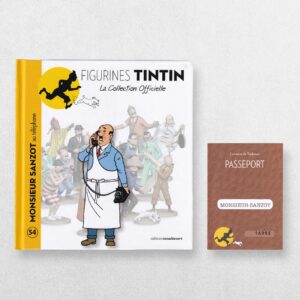
Fakir Cipaçalouvishni – Figurines Tintin La Collection Officielle – 107 – Le Fakir Cipaçalouvishni

Hergé & Editions Moulinsart

£75.00

Availability: In stock

Product Description

Fakir Cipaçalouvishni – Figurines Tintin La Collection Officielle – 107 – Le Fakir Cipaçalouvishni

Author: Hergé & Editions Moulinsart
Price: £75.00
Publisher: Editions Moulinsart

Publication date: 2015
Format: Original pictorial boards with passport and figurine
Condition: In near fine condition
Illustrations: Illustrated throughout

Description:

Original pictorial boards. Includes passport loosely inserted. Text in French. Includes the accompanying figurine. One from the collection of 111 books and figurines. Very slight wear. In very near fine, clean condition overall.

Fakir Cipaçalouvishni: A Short Biography

The Fakir Cipaçalouvishni is a mysterious and sinister figure who appears in Cigars of the Pharaoh (Les Cigares du Pharaon, 1934; revised 1955)*. He is one of the earliest examples of Hergé’s fascination with Eastern mysticism, hypnosis, and the psychology of fear, themes that recur throughout the Tintin canon. Although his role is brief, the Fakir leaves a striking impression. He operates within the network of an international drug-smuggling organisation and serves as both a mesmerist and an assassin, using hypnosis as a weapon.

Character Overview

AttributeDescription
NameCipaçalouvishni
Title in FrenchLe fakir Cipaçalouvishni
OccupationFakir, hypnotist, and agent of the criminal drug ring
First AppearanceCigars of the Pharaoh (Les Cigares du Pharaon, 1934; redrawn 1955)
NationalityIndian (fictionalised depiction)
AffiliationThe secret opium-smuggling organisation symbolised by the Kih-Oskh mark
Personality TraitsCold, calculating, mysterious, ruthless
SymbolismThe danger of misused spiritual power and the Western fear of the “mystic East”

Narrative Context

In Cigars of the Pharaoh, Tintin becomes entangled in a web of intrigue stretching from Egypt to India. The story introduces a secret criminal society that uses mummification and mystic imagery as instruments of terror. The Fakir Cipaçalouvishni serves as one of its most visible agents. When Tintin reaches India, the Fakir uses hypnotism to manipulate victims and silence witnesses. His attempts to subdue Tintin and protect the organisation’s secrecy make him a direct, though short-lived, antagonist.

Characterisation

Hergé portrays the Fakir as disciplined, poised, and terrifyingly calm. His power lies not in physical violence but in psychological domination. The scenes in which he hypnotises others mark one of the earliest uses of psychological suspense in the Tintin series.

Key Traits

  • Hypnotic Skill: He can induce sleep or paralysis with his eyes or gestures.
  • Composure: Never flustered, even under pressure.
  • Fanatic Loyalty: Obeys his masters within the drug ring without question.
  • Inhuman Detachment: Treats victims as pawns, showing no compassion.

Cipaçalouvishni is thus less a character of emotion than of symbolic control—a manifestation of fear and manipulation in human form.

Function in the Story

The Fakir’s primary role is to personify the invisible menace of the criminal organisation. His hypnotic powers literalise the idea that corruption and evil can control the minds of others. He also functions as Tintin’s bridge from the rational West to the mystical East. His appearance coincides with the story’s shift from archaeology and adventure to spiritual illusion and hallucination. When Tintin resists his hypnosis, it symbolises reason triumphing over superstition, a recurring motif in Hergé’s early moral framework.

Symbolic and Thematic Analysis

ThemeInterpretation
Mind Control and FearHypnosis represents the surrender of free will; the Fakir weaponises faith and ritual.
East–West EncounterReflects early-20th-century European fascination—and misunderstanding—of Eastern mysticism.
Science vs. SuperstitionTintin’s resistance affirms Enlightenment rationality against irrational fear.
Moral Corruption of KnowledgeThe Fakir’s spiritual training, intended for enlightenment, is distorted into criminal service.

Hergé would later refine such moral complexity in characters like Doctor Krollspell and Professor Calculus, where knowledge or intellect carries ethical responsibility.

Artistic Depiction

Hergé’s ligne claire style presents the Fakir with a blend of realism and theatrical menace:

  • Appearance: Tall, slender, dark-skinned, wearing a turban and loincloth, consistent with early Western depictions of fakirs.
  • Expression: Intense eyes and a calm face—his hypnotic weapon.
  • Body Language: Upright posture and graceful gestures suggest both discipline and danger.

In the 1955 redrawn version, the design becomes less caricatural and more dignified, reflecting Hergé’s growing sensitivity to cultural portrayal.

Cultural and Historical Reading

The Fakir Cipaçalouvishni originates from a period when European popular culture often exoticised India as a land of magic and mystery. While the character uses tropes of Oriental mysticism, Hergé’s later revision tempers earlier stereotypes. The updated artwork and narrative framing transform the Fakir from a racial caricature into a psychological adversary, more aligned with the espionage thrillers of the 1950s. Thus, the Fakir becomes a transitional figure—a relic of pulp adventure reinterpreted through Hergé’s maturing worldview.

Comparison with Other Tintin Villains

CharacterType of EvilMotivation
RastapopoulosGreed and manipulationWealth and control
Doctor MüllerScientific amoralityPower through knowledge
The Fakir CipaçalouvishniSpiritual corruptionBlind obedience to secret masters

His particular menace lies not in ambition but in servitude—he embodies evil carried out without thought or self-interest, the instrument rather than the origin of crime.

Summary

AspectDescription
NameCipaçalouvishni
TitleThe Fakir Cipaçalouvishni
RoleHypnotist and agent of the Kih-Oskh organisation
First AppearanceCigars of the Pharaoh (1934; rev. 1955)
PersonalityCold, fanatically obedient, manipulative
SymbolismThe misuse of spiritual power and the seduction of fear
Visual IdentityTall, serene, hypnotic presence
Narrative FunctionEmbodies the invisible control of criminal power
LegacyEarly step toward Hergé’s mature exploration of psychology and morality

Conclusion

The Fakir Cipaçalouvishni stands as one of Hergé’s earliest experiments with psychological menace and spiritual ambiguity. Neither brute nor buffoon, he is a figure of intellectual and moral distortion—a man whose sacred discipline has been emptied of virtue and filled with obedience to evil. Through him, Cigars of the Pharaoh bridges the gap between the light adventure of early Tintin and the darker, more philosophical tone of Hergé’s later work. Cipaçalouvishni’s calm eyes and quiet gestures thus remain emblematic of an enduring truth in Hergé’s world: that evil often speaks softly, cloaked in mystery, and wielding knowledge without conscience.

Why Buy from Us?

At Hornseys, we are committed to offering items that meet the highest standards of quality and authenticity. Our collection of objects and rare books are carefully curated to ensure each edition is a valuable piece of bibliographical history. Here’s what sets us apart:

  • Authenticity and Provenance: Each item is meticulously researched and verified for authenticity and collation.
  • Expert Curation: Our selection process focuses on significance, condition, and rarity, resulting in a collection that is both diverse and distinguished.
  • Customer Satisfaction: We aim to provide an exceptional customer experience, from detailed descriptions to secure and prompt delivery of your purchase.
  • Returns Policy: We offer an unconditional guarantee on every item. If you wish to return an item, it may be sent back to us within fourteen days of receipt. Please notify us in advance if you wish to do so. The item must be returned in the same condition as it was sent for a full refund.

Cataloguer: Daniel Hornsey

Daniel Hornsey has specialised in fine and rare books, ephemera, and collectors’ editions for over thirty years. As a long-standing member of the antiquarian book trade, he has advised private collectors, curated catalogues, and sourced works for leading dealers, libraries and institutions across the world.

Hornseys’ exhibit regularly at book and map fairs in London and throughout the UK and are members of the Provincial Booksellers Fairs Association, the PBFA.

His fascination with Hergé’s work — especially ‘The Adventures of Tintin’ — began in childhood. Daniel recalls reading Tintin in original European editions and quickly recognising that these were not merely children’s books, but finely illustrated narratives crafted with artistic depth and wit.

As noted by the Musée Hergé in Louvain-la-Neuve, Hergé’s ‘ligne claire’ style has influenced generations of European comic artists and his original drawings and paintings command very high prices with his painting of ‘The Blue Lotus’ jar fetching £2.8m at auction in 2021.

By presenting these works through Hornseys’, he hopes to contribute to the continued appreciation of one of the 20th century’s most influential illustrators, helping new generations discover the artistry and legacy of Hergé.

You may also like…