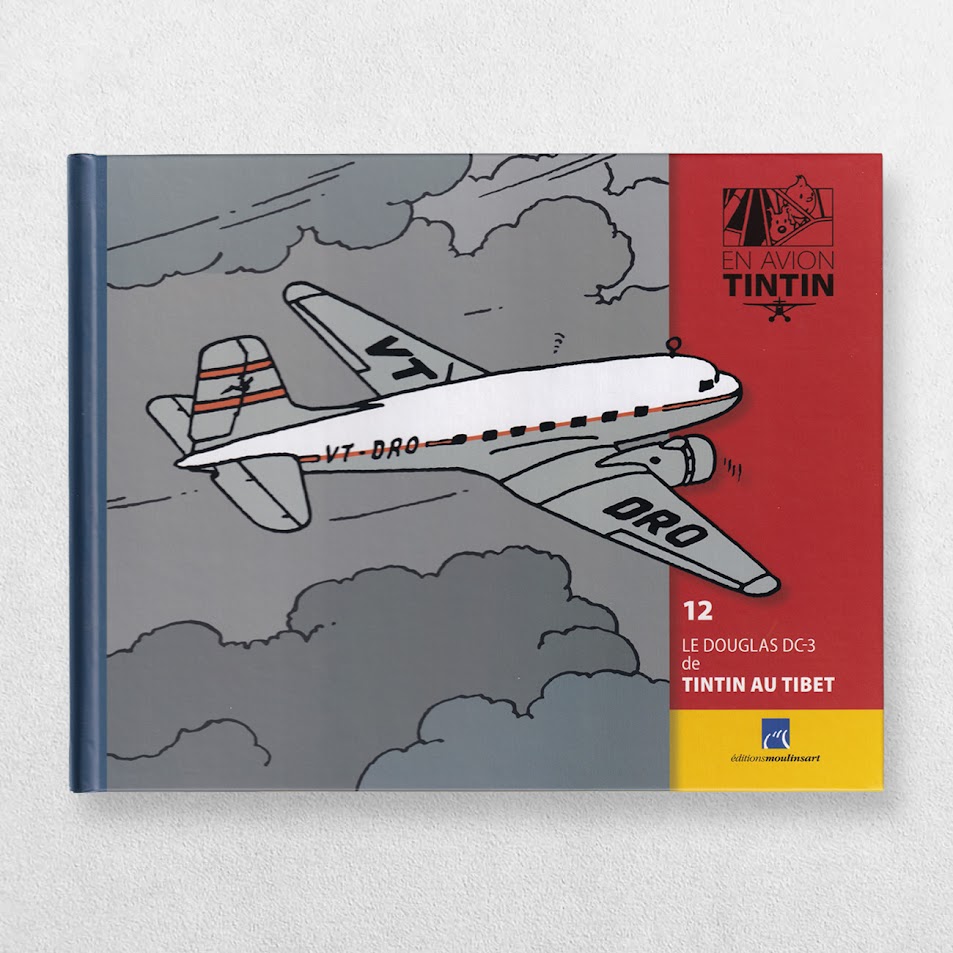
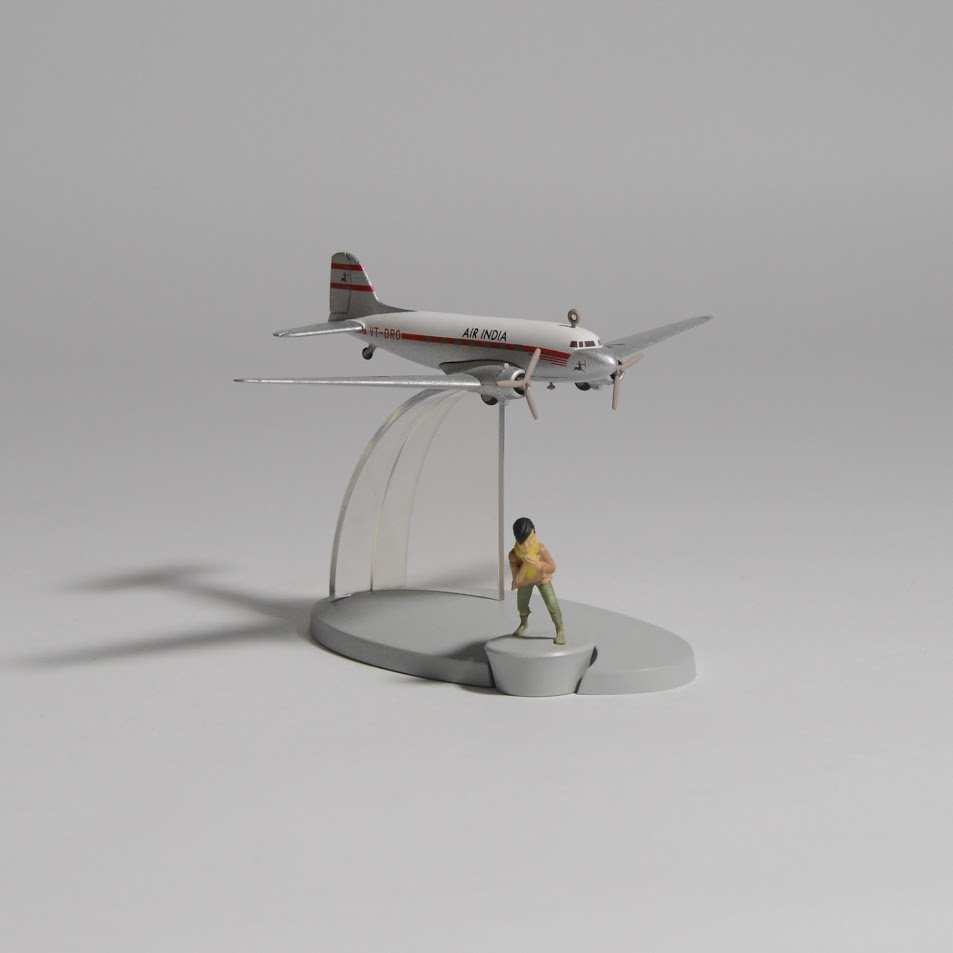
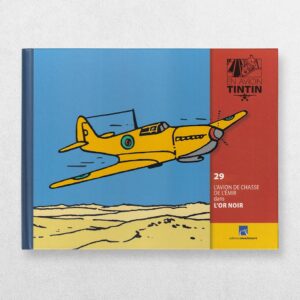
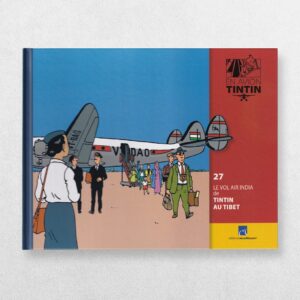
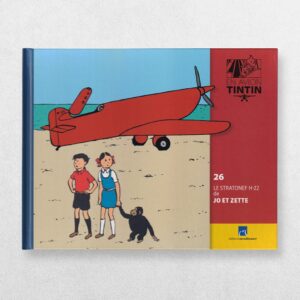
Tintin By Plane – 12 – The Douglas DC-3 In Tintin In Tibet – Le Douglas DC-3 De Tintin Au Tibet – En Avion Tintin
Author: Hergé & Editions Moulinsart
Price: £85.00
Publisher: Editions Moulinsart
Publication date: 2014
Format: Original pictorial boards with plane on plinth
Condition: In near fine condition
Illustrations: Illustrated throughout
Description:
Original pictorial boards. Text in French. Includes the accompanying model and figurine. One from the collection of 50 books and models. Very slight wear. In very near fine, clean condition overall.
The Douglas DC-3: A Brief History
The Douglas DC-3 is one of the most important and influential aircraft ever built — a masterpiece of engineering that revolutionised both commercial aviation and military transport. Introduced in the mid-1930s by the Douglas Aircraft Company of Santa Monica, California, the DC-3 transformed air travel from an expensive novelty into a practical, reliable, and global industry. Its impact was so profound that it became a symbol of twentieth-century modernity, endurance, and progress.
Origins and Design
The Douglas DC-3 first flew on 17 December 1935, just thirty-two years to the day after the Wright Brothers’ first flight. It was developed from the earlier DC-2 at the request of American Airlines, which wanted a larger, more comfortable sleeper aircraft for transcontinental service. The result was a twin-engine monoplane with a metal stressed-skin fuselage, low wing, and retractable undercarriage — a design that combined aerodynamic efficiency with robust practicality.
The aircraft was powered by two Pratt & Whitney R-1830 Twin Wasp or Wright R-1820 Cyclone radial engines, each producing between 1,000 and 1,200 horsepower, giving it a cruising speed of around 180 mph (290 km/h) and a range of 1,500 miles (2,400 km). It typically carried 21 to 32 passengers in comfort, with space for a small crew of three: pilot, co-pilot, and stewardess.
The DC-3’s real innovation lay in its economy and reliability. It could make money carrying passengers alone, without relying on government mail contracts — a first in aviation history. It was easy to maintain, capable of operating from rough or short airstrips, and strong enough to endure almost any climate or condition.
Civil and Commercial Legacy
By the late 1930s, the DC-3 had become the backbone of commercial aviation. Airlines such as KLM, Pan American, American Airlines, TWA, and Imperial Airways (later BOAC) adopted it enthusiastically. Its introduction brought about a global expansion of scheduled air routes, reducing transcontinental travel times from days to hours and making international air travel a realistic possibility for business and leisure passengers alike.
In Europe, the DC-3 (known in some countries as the Douglas Dakota) quickly earned a reputation for dependability. Its influence extended far beyond the United States: by the outbreak of the Second World War, it had become a truly international aircraft, licensed for production in the Soviet Union as the Lisunov Li-2 and in Japan as the Showa L2D.
The Wartime “Dakota”
During the Second World War, the DC-3 was adapted into the C-47 Skytrain (known in British service as the Dakota). It became the logistical backbone of the Allied war effort, used for troop transport, supply drops, medical evacuation, and paratrooper operations — most famously during D-Day and the Berlin Airlift. The aircraft’s toughness and versatility earned it a near-mythic status among pilots and ground crews alike.
More than 10,000 military variants were built, and countless civilian DC-3s were requisitioned for wartime service. After 1945, many of these aircraft returned to civilian life, providing the foundation for the rapid post-war expansion of commercial aviation worldwide.
Enduring Legacy
Few machines have demonstrated such longevity. The DC-3’s combination of simplicity, strength, and reliability has kept it flying for nearly ninety years. Many are still in operation today — in cargo transport, skydiving, and tourism — a testament to the aircraft’s timeless engineering. Aviation historians often remark that “the only replacement for a DC-3 is another DC-3,” a phrase that perfectly encapsulates its reputation.
Its influence on later designs is equally profound. The pressurised Douglas DC-4, DC-6, and DC-7, as well as numerous modern turboprops, owe much to the DC-3’s structural and aerodynamic principles. Beyond technology, the aircraft came to symbolise the optimism and ingenuity of an age when flight was still an adventure — a human achievement grounded in both imagination and engineering precision.
Conclusion
The Douglas DC-3 remains one of the defining creations of the twentieth century — not merely a successful aircraft, but a cultural landmark. It connected continents, carried armies, and helped to build the modern world. Its appearance in literature, film, and art — including Hergé’s Tintin universe — underscores its iconic status. Graceful in design, flawless in function, and virtually indestructible in service, the DC-3 endures as a living emblem of aviation’s golden age: a machine that truly changed the way the world moved.
Air India: A Brief History
Air India is the flag carrier airline of the Republic of India and one of the most storied names in global civil aviation. Founded in the early twentieth century, its history mirrors the evolution of modern India itself — from colonial enterprise to post-independence statehood, through challenges of modernisation, globalisation, and renewal. The airline’s journey is marked by both pioneering achievements and periods of turbulence, yet its cultural and historical importance remains enduring.
Origins: Tata Airlines and the Birth of Indian Aviation (1932–1946)
Air India began life as Tata Airlines, founded on 15 October 1932 by the industrialist and aviator J. R. D. Tata, then head of the Tata Group. J. R. D., himself a licensed pilot, envisioned a commercial air service connecting the vast regions of British India by air — a bold venture in a country with limited infrastructure and no previous aviation tradition.
The airline’s inaugural flight took off from Karachi to Bombay (now Mumbai) in a single-engine de Havilland Puss Moth, piloted by Tata himself, carrying mail for Imperial Airways. From there, the route extended to Madras (now Chennai), establishing the first regular domestic airmail service in India. The fledgling airline soon expanded, adding more aircraft such as the de Havilland Dragon and Lockheed Electra, and carrying both passengers and cargo.
Despite limited resources, Tata Airlines quickly earned a reputation for safety, efficiency, and professionalism — qualities that would become hallmarks of Air India’s brand.
Becoming Air India and the Post-War Expansion (1946–1948)
After the Second World War, civil aviation experienced rapid global growth. In 1946, Tata Airlines became a public company and was renamed Air India Limited. Two years later, with India’s independence in 1947, the government recognised the need for a national flag carrier that could represent the new nation abroad.
In 1948, the Government of India acquired a 49% stake in Air India, forming a new entity, Air India International Limited, to operate long-haul routes. On 8 June 1948, the airline inaugurated its first international service — a flight from Bombay to London via Cairo and Geneva — using a Lockheed Constellation L-749A. The occasion marked India’s official entry into the global aviation network.
The airline’s emblem — the centaur from Greek mythology, symbolising strength and speed — and its slogan, “Your Palace in the Sky,” encapsulated the elegance and ambition of the early jet age.
The Golden Age: The Jet Era and Global Prestige (1950s–1970s)
During the 1950s and 1960s, under the visionary leadership of J. R. D. Tata and the creative direction of designer Bobby Kooka, Air India became a byword for sophistication and excellence. The introduction of the Boeing 707 in 1960 made it the first Asian airline to enter the jet age, ahead of many European carriers. The airline’s distinctive red-and-white livery, with its Maharajah mascot, became instantly recognisable worldwide.
Air India’s marketing was as stylish as its service: it combined traditional Indian hospitality with cosmopolitan flair. Cabin crews wore elegant saris; menus featured regional Indian cuisine alongside Western dishes; and the airline’s promotional art blended humour, charm, and cultural pride. The Maharajah — a cartoon figure with a turban, moustache, and genial expression — came to symbolise warmth, luxury, and refinement.
The airline’s routes expanded rapidly across Europe, the Middle East, Africa, Southeast Asia, and North America. It was frequently ranked among the world’s best, representing India on the world stage with dignity and confidence.
Nationalisation and the Challenges of State Control (1953–1980s)
In 1953, the Indian government nationalised civil aviation, merging Air India International and several smaller domestic airlines (including Indian Airlines Corporation) under state ownership. Air India continued to operate international routes, while Indian Airlines managed domestic services.
Although the move was intended to streamline operations, government ownership introduced bureaucratic inefficiencies and curtailed the entrepreneurial dynamism that had defined Tata’s leadership. J. R. D. Tata remained as Chairman until 1978, but his influence waned under increasing political interference.
Nevertheless, the airline maintained high standards throughout the 1960s and 1970s. It added Boeing 747 “Jumbo Jets” to its fleet in 1971, branding them as “Palaces in the Sky.” The distinctive aircraft, with peacock motifs and traditional Indian patterns decorating the cabin interiors, symbolised both modernity and heritage.
Turbulence and Tragedy (1980s–1990s)
The 1980s brought both triumph and tragedy. In 1982, Air India became one of the first airlines to operate the Boeing 747-300, reaffirming its commitment to technological modernisation. However, disaster struck on 23 June 1985, when Air India Flight 182, a Boeing 747 named Kanishka, was destroyed by a terrorist bomb over the Atlantic Ocean, killing all 329 people on board. It remains one of the worst aviation disasters in history and a defining moment of grief for the Indian diaspora.
In the following decade, Air India faced increasing competition from international carriers, rising fuel costs, and operational inefficiencies. While its service remained respected, its reputation suffered from outdated aircraft and bureaucratic management.
Liberalisation and Decline (1990s–2000s)
India’s economic liberalisation in the early 1990s transformed the aviation landscape. Private carriers such as Jet Airways, Sahara, and later IndiGo and SpiceJet, introduced competition that eroded Air India’s long-held dominance.
Attempts at modernisation — including fleet renewal with Airbus A310s, Boeing 747-400s, and later Boeing 777s — were offset by financial losses and management challenges. The 2007 merger of Air India with Indian Airlines was intended to create a single, efficient national carrier but instead produced overlapping structures and severe debt. By the early 2010s, the airline was struggling with heavy financial burdens, frequent strikes, and declining market share.
Privatisation and Revival (2021–Present)
In 2021, after nearly seventy years of state ownership, Air India returned to its original founder: the Tata Group, which won the government’s global bidding process to reacquire the airline. The move marked a historic full circle in Indian aviation history.
Under Tata’s stewardship, Air India began an ambitious transformation plan — modernising its fleet, upgrading service standards, improving punctuality, and rebuilding brand identity. In 2022, the airline placed one of the largest aircraft orders in aviation history: 470 new planes (250 from Airbus and 220 from Boeing), signalling a confident revival strategy.
The airline’s renewed focus on professionalism, digital innovation, and global connectivity has already begun to restore confidence among travellers and industry observers.
Cultural and Historical Legacy
Beyond its operational record, Air India holds a unique place in India’s national identity. Its Maharajah mascot and global presence made it an early ambassador of Indian culture, long before the country’s rise as an economic power. Its advertising, often witty and artistically refined, was acclaimed internationally and helped shape perceptions of modern India as both gracious and forward-looking.
Air India also played an important humanitarian role: conducting evacuation flights during wars, natural disasters, and the COVID-19 pandemic — a reflection of its enduring national service ethos.
Conclusion
The story of Air India is the story of Indian aviation itself — visionary in origin, turbulent in midlife, and now entering a phase of renewal. From J. R. D. Tata’s pioneering mail flight in 1932 to the airline’s twenty-first-century resurgence under the same corporate family, Air India’s journey spans nearly a century of technological, cultural, and political change.
Today, with a modern fleet, revitalised leadership, and a renewed commitment to excellence, Air India stands poised to reclaim its place among the world’s leading airlines — not only as a carrier of passengers, but as a symbol of India’s enduring spirit of innovation, resilience, and pride.
Tintin in Tibet: A Brief Summary
Tintin in Tibet, first published in 1960 in French, is the twentieth volume in Hergé’s The Adventures of Tintin. Unlike many other titles in the series, it is not driven by political intrigue, treasure hunts, or crime. Instead, it stands out as a deeply personal tale of friendship, loyalty, and spiritual endurance. Set against the dramatic backdrop of the Himalayas, the story is widely considered one of Hergé’s finest works for its emotional depth and striking atmosphere.
The Dream and the Call to Action
The narrative begins while Tintin is on holiday with Captain Haddock and Professor Calculus in the Alps. Tintin dreams of his young Chinese friend Chang, whom he last met in The Blue Lotus. In the dream, Chang appears to be in great danger. The following morning, Tintin learns that a plane flying over the Himalayas has crashed, and that Chang was aboard. Despite official reports declaring all passengers dead, Tintin remains convinced Chang has survived. Guided by a sense of loyalty and intuition, he resolves to travel to Tibet to search for his friend.
Journey to the Himalayas
Tintin, Haddock, and Snowy make their way to Kathmandu and then on to the mountain regions of Nepal. Their travels introduce them to local guides, monasteries, and the stark landscapes of the Himalayas. Hergé’s meticulous research is evident in his accurate depictions of Tibetan culture and geography.
Captain Haddock provides much of the comic relief, grumbling about the dangers and discomforts of the journey, yet his loyalty to Tintin never falters. Snowy also contributes to the narrative, braving the harsh conditions and lending both humour and pathos to the expedition.
Encounters with the Unknown
As the group advances through treacherous terrain, they find signs suggesting that Chang may indeed be alive. Footprints in the snow, mysterious sounds, and fleeting glimpses of a shadowy figure point to the presence of the legendary Yeti. These clues sustain Tintin’s belief in Chang’s survival and propel the search further into dangerous territory.
The Yeti becomes a haunting presence throughout the narrative, depicted not as a monster but as a mysterious and ambiguous figure. Hergé’s portrayal blends folklore with compassion, casting the creature as a guardian rather than a threat.
The Rescue
After enduring avalanches, exhaustion, and near despair, Tintin finally discovers Chang, injured but alive, in a remote cave. Chang recounts how he was carried and protected by the Yeti after the crash, offering a moving reversal of expectations about the creature. The Yeti, far from being a terror of the mountains, is shown as a lonely, almost tragic being capable of compassion.
The reunion between Tintin and Chang is one of the most emotional moments in the series, underscoring the themes of loyalty, friendship, and hope that define the book.
Themes and Emotional Depth
Unlike other Tintin adventures, Tintin in Tibet contains no villains, political subplots, or hidden treasures. Instead, the central conflict is man against nature and, more profoundly, Tintin’s unwavering determination to find his friend against all odds. The story reflects values of courage, compassion, and faith in intuition.
The book is often interpreted as a reflection of Hergé’s own state of mind at the time of its creation, when he was undergoing personal struggles. Its purity of narrative and emotional sincerity give it a unique place within the Tintin canon.
Conclusion
Tintin in Tibet is a masterpiece of comic storytelling, notable for its quiet intensity and its exploration of the human spirit. Through Tintin’s relentless search for Chang and the compassionate depiction of the Yeti, Hergé created a narrative that resonates far beyond adventure. The album stands as a moving testament to loyalty, friendship, and hope, ensuring its enduring reputation as one of the greatest entries in The Adventures of Tintin.
Why Buy from Us?
At Hornseys, we are committed to offering items that meet the highest standards of quality and authenticity. Our collection of objects and rare books are carefully curated to ensure each edition is a valuable piece of bibliographical history. Here’s what sets us apart:
- Authenticity and Provenance: Each item is meticulously researched and verified for authenticity and collation.
- Expert Curation: Our selection process focuses on significance, condition, and rarity, resulting in a collection that is both diverse and distinguished.
- Customer Satisfaction: We aim to provide an exceptional customer experience, from detailed descriptions to secure and prompt delivery of your purchase.
- Returns Policy: We offer an unconditional guarantee on every item. If you wish to return an item, it may be sent back to us within fourteen days of receipt. Please notify us in advance if you wish to do so. The item must be returned in the same condition as it was sent for a full refund.
Cataloguer: Daniel Hornsey
Daniel Hornsey has specialised in fine and rare books, ephemera, and collectors’ editions for over thirty years. As a long-standing member of the antiquarian book trade, he has advised private collectors, curated catalogues, and sourced works for leading dealers, libraries and institutions across the world.
Hornseys’ exhibit regularly at book and map fairs in London and throughout the UK and are members of the Provincial Booksellers Fairs Association, the PBFA.
His fascination with Hergé’s work — especially ‘The Adventures of Tintin’ — began in childhood. Daniel recalls reading Tintin in original European editions and quickly recognising that these were not merely children’s books, but finely illustrated narratives crafted with artistic depth and wit.
As noted by the Musée Hergé in Louvain-la-Neuve, Hergé’s ‘ligne claire’ style has influenced generations of European comic artists and his original drawings and paintings command very high prices with his painting of ‘The Blue Lotus’ jar fetching £2.8m at auction in 2021.
By presenting these works through Hornseys’, he hopes to contribute to the continued appreciation of one of the 20th century’s most influential illustrators, helping new generations discover the artistry and legacy of Hergé.